
Follow up study confirms no sign of badger culls having an effect on cattle TB after 8 years in the LRA, as with findings from the HRA and Edge areas.
In 2023, seven independent experts compiled a review for MP’s of all parties on the first five years of badger culling and vaccination in England’s Low Risk Area, (see here).
Defra were sent the report but did not comment. They maintained their highly irregular and anti-democratic refusal to engage with anyone who does not concur with their views on bovine TB science.
The Bovine tuberculosis (bTB) ‘Low Risk Area’ (LRA) of England was established in 2013, as cattle trading spread the disease further into central and northern England. The LRA constitutes just over half the geographic area of England, largely land to the east and north of the country, including Cumbria.
The 2023 report had outlined how and why the LRA bTB control area of England was missing its targets. It is now clear that there has been a failure to reduce the disease effectively by 2025, in accordance with the stated aims and objectives of Defra’s original disease control policy and plans.
Three years on from that first report, data from 2024-2026 has been added to give an even clearer picture (see here), of how little contribution badger culling has made. The headline points are:
- The four counties involved are: Cumbria, Lincolnshire, Nottinghamshire and Leicestershire.
- APHA handing of cattle movement restrictions following confirmation of a breakdown in the LRA is inadequate and may assist spread of disease
- Badger culling is often used once cattle breakdowns have already diminished as a result of increased testing frequency.
- Defra have developed a culture of implementing badger culling/vaccination when there is an unproven suspicion of disease risk. This does not result in any measurable disease effect, but they say it is necessary and can go on for ever.
- Badger culling has been a completely unevidenced and epidemiologically senseless intervention used to appease farmer (NFU) demands.
- Bovine TB continues to persist in areas where badger control has taken place. This is due to inadequate cattle measures.
The Government’s 25-year bTB control strategy, published in 2014, aimed to obtain Officially TB-Free status for England by 2038. Reaching this target is looking increasingly unlikely using current approaches, even with large expenditure from public subsidy. The 2025 LRA TB-Free targets have been missed due to Defra cattle disease control failures.
While current bTB measures do act to identify breakdowns as infected cattle are traded into the low-risk area on a monthly basis, there are signs that measures to deal with hotspots have been too limited to be effective. Tracing of strains in areas with low levels of infection is restricted. This is because sampling sites for strain type determination are largely determined by identification of lesions at post mortem.
Evidence for efficacy of badger interventions (badger culling and vaccination) in the LRA remains absent, much as it is for badger culling in the High Risk and Edge Areas. While cattle measures have clearly helped reduce breakdown incidence, one measure of infection, there is no evidence of the sharp decline that is typical of effective disease control measures working.
Events are consistent with the now widely accepted peer reviewed evidence that the main badger culling trial in the British Isles (RBCT 1998-2005) was poorly designed and did not carry out statistical analysis of data in a biologically credible way (see here). Evidence leading to a hypothesis for the bTB perturbation effect of badgers spreading bovine TB is now accepted as unevidenced. At present, it is uncertain whether badger plays a significant role in bovine TB spread in cattle, any more than any other wild mammals infected due to the persistent cattle bTB epidemic. This is an epidemic that has infected the countryside via extensive spreading of bTB infected cattle excreta.
Government bTB wildlife interventions are implemented for an ‘anticipated benefit’ rather than an evidence-based, visible or recordable benefit. Actions are decoupled from clear and direct scientific evidence, and this is an unsustainable position that is not supported by veterinary ethics or wildlife considerations.
As such, the LRA badger interventions are an exemplar of why Defra’s push towards industry-led targeted culling (or cluster culling or epi-culling – very similar to LRA culling), at the behest of the Chief Veterinary Officer, is such a dangerous step in normalizing unproven and hugely wasteful veterinary intervention.
The authors view is that enhanced sensitivity of cattle testing is needed to control and eradicate local spread of TB in cattle in all risk areas of the UK and beyond. Without this, the epidemic will simply perpetuate, as it has done for decades in the Republic of Ireland where badger culling has been continuously practiced, with no evidence of any endpoint to the decades-long epidemic.
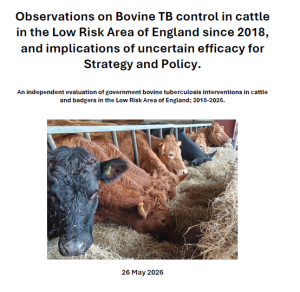
You can read the new report here.
Discover more from The Badger Crowd - standing up for badgers
Subscribe to get the latest posts sent to your email.