
Field experiments and transmission models
Since a badger was first found with bovine TB (bTB) in 1971, there has been ongoing debate around any role they may play in sustaining the disease in cattle herds across Britian and Ireland. Are they an important host or (like many other mammals) just ‘spillovers’, susceptible because of the way they forage on the ground across land contaminated by cattle, and inevitably constantly exposed to bacteria? Are they an ‘important reservoir’ as so many publications now routinely suggest? How strong is the evidence for an intervention effect? How reliable are the simulation models that claim disease control efficacy and economic benefit for use in policy ? The field studies on which the answers to these questions are based ranged from small scale efforts involving just a few herds and badgers, to larger studies such as the Four Areas Project in Ireland and the Randomised Badger Culling Trial (RBCT) in England.
A new systematic review of interventions
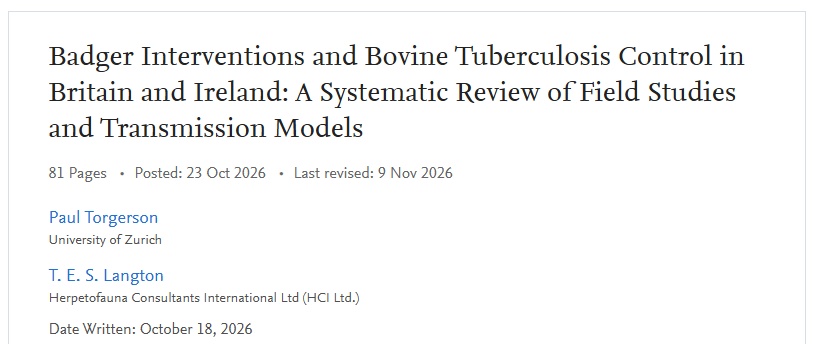
Scientists independent of government employment or funding have reviewed the studies which have examined the relationship between badger interventions (culling and/or vaccination) and cattle breakdowns. The results of this review have been submitted for publication and can be read as a pre-print here. The ‘field experiments’ review filtered over 100 publications, focussing on 25 relevant studies. Located in England, Wales, Northern Ireland and the Republic of Ireland, the studies have been critically assessed for reliability.
One of the most striking observations of the new review is how the science went awry so rapidly from the 1970’s. The previously established and well documented cattle disease pathology was replaced with a government (MAFF) narrative. This claimed that test reactors that were not found to have visible lesions at post-mortem had no, or a low risk of disease transmission. This contradicted the established science used to control bTB in the 1960’s. With no clear explanation of why or how, only ‘confirmed’ reactors were treated as a disease transmission risk. The potential infectious nature of ‘unconfirmed reactor’ cattle was demoted to inconsequential, and the role of badgers was promoted as the main problem.
These misconceptions led to field experiments that began with the wrong premise. Most started with a working assumption that badgers were causing many or most of herd breakdowns, then tried to calculate the proportion of the disease they were responsible for. They were looking to quantify the number or proportion of badgers you would need to kill to help control disease in cattle. They were not asking the right questions.
The new systematic review takes each experiment and analysis, and outlines how the assumptions made, the degree of methodological rigor employed, the statistical choices taken, and the resulting study limitations, all affect the conclusions that were drawn. It is stark in its documentation of the multiple analytical problems and dubious assumptions used to conclude that badger interventions are indicated as viable disease control measures.
The pre-print also undertakes a systematic review of the 17 key bTB transmission simulation models and analytical frameworks that have attempted to predict the outcome of applying badger interventions. These simulations base their models on selective use of badger intervention studies. As such, their outputs reflect analytical choices rather than biological reality, perhaps to conform with expectations. And since the baseline field trial results have been shown to lack statistical robustness, the simulation models that are founded upon them lack epidemiological reality – they simply copy expectation; the software is incorrectly attributing missed domestic cattle transmission to external wildlife sources.
Several models pre-program badgers to cause a set percentage of all cattle breakdowns, making the results a direct consequence of initial inputs. Other models fail to include domestic cattle movements, trade networks, and winter-housing transmission entirely. These models fail to account for two-way transmission from cattle back to badgers and assume the the tuberculin (SICCT) test has perfect sensitivity, when it is actually only 50-80%. They operate a ‘closed loop’ that cannot provide reliable guidance for field epidemiology and disease control considerations.
Whole Genome Sequencing (WGS)
Having historically relied all but entirely upon on field experiments for policy, (most notably the now discredited RBCT), and for badger culling strategy, government advisors are now looking elsewhere to justify old assumptions. The Godfray Review update of policy science (2025) stated:
“The continued and expanded use of whole genome sequencing (WGS) to provide quantitative insights into disease prevalence in wildlife and the extent of wildlife-cattle and cattle-wildlife transmission will be key to tailoring geographical specific control strategies.”
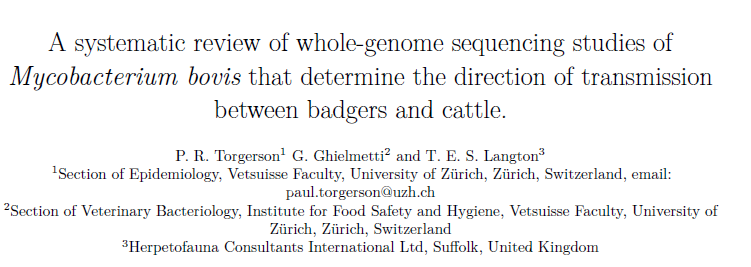
Hence WGS is being promoted as a new route to substantiate badger interventions and intervention based interpretations. A new systematic review of the analytical frameworks and sampling protocols supporting these WGS based claims of transmission direction can be read here.
It shows how the reported dominance of badger-to-cattle transmission is in reality a mathematical artifact of uncorrected surveillance differences (uneven sampling), model misspecification, and structural constraints, rather than reflecting actual biological events. It concludes that the currently published genomic and phylodynamic models do not provide reliable evidence of significant transmission from badger to cattle. Further, it recommends that without the kind of highly detailed and long term study recommended by some of the papers examined, WGS evidence is an unsafe guide for disease control.
A modern tragedy of veterinary misadventure
Tragically for all concerned, the result of the incorrect interpretation of the certainty of the collective bovine TB and wildlife science to-date, has misdirected government policy for a generation. It has led to the culling of over 300,000 mostly healthy badgers in Britian and Ireland, with unmeasured unlawful culling. Government has been unable to demonstrate any disease benefit from the cull and merely associates herd breakdown change according to an expectation that hold no veracity.
Perhaps worse than this, is the continued use of the same uncertain and inconclusive science in strategic documents (see here). So with governments under pressure from industry, the same mistaken science could result in a return to badger culling in England. Meanwhile, Northern Ireland and Wales are currently looking to the same evidence-base to draw up their own bovine TB control policies. Without acceptance of the fundamental limitations and weaknesses of bovine TB and wildlife research to-date, and an understanding of how grave misconceptions were formed and have been perpetuated, the same mistakes could be repeated.
Discover more from The Badger Crowd - standing up for badgers
Subscribe to get the latest posts sent to your email.