A new article in the May issue of British Wildlife magazine provides an overview of the current state of affairs with badger culling in England, and a welcome update on the science surrounding the issue.
It looks at new work that questions the role that badgers play in bovine TB in cattle, and what the most likely reasons behind the perpetuation of the disease are.
It also looks at the problems that badger culling is likely to be causing to the ecosystem in general, and whether or not this is being adequately monitored or mitigated.
There is a potted history of legal challenges to the badger cull, and a view on the insight and benefits that this difficult work has provided.
It looks at where the current government intends to take the badger culling policy next, and what ‘epidemiological culling’ could mean for our badgers in the future.
You can access a copy of the article here, for a charge of 99p.
The amendment, moved by The Earl of Caithness, was described thus:
47: Clause 17, page 20, line 34, at end insert—“(3) In subsection (1)(b), developments in scientific understanding must be identified based upon regular reviews of the scientific evidence.(4) When undertaking a review of scientific evidence referred to in subsection (3), the relevant national authority must consider the methodological quality of the evidence, in terms of the extent to which all aspects of a study’s design, data collection protocols and statistical analysis can be shown to protect against systematic bias, non-systematic bias, and inferential error.(5) Where regulations under subsection (1) constitute environmental law, the review of scientific evidence must also consider whether the evidence takes a sufficiently wide view of the ecological impacts.”Member’s explanatory statementThis amendment is to ensure that future regulations will be based on a proper assessment of the best science available.
Member’s explanatory statement: This amendment is to ensure that future regulations will be based on a proper assessment of the best science available.
Lord Krebs was at last nights debate and said:
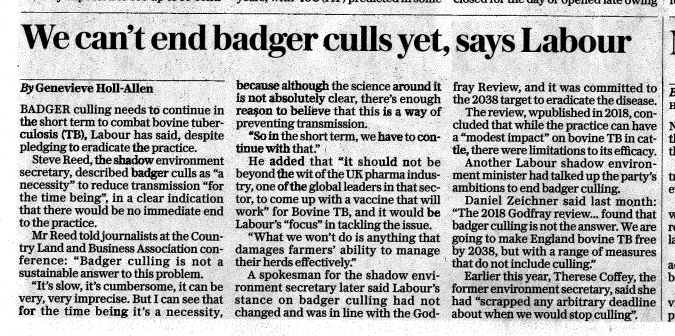
“I support in large part what he said about the importance of rigorous scientific evidence to underpin policy—he referred to the environment, but I would say more broadly. I will add a note of caution from my personal experience. As many noble Lords will know, I was responsible for instigating the randomised badger culling trials, the so-called “Krebs trials”, which were meant definitively to determine whether killing badgers was a good way of controlling bovine tuberculosis. The trial was probably the largest ecological experiment ever done in this country; it did produce results, but it did not settle the arguments or the policy. So science has an important role to play, and I support the noble Earl’s amendment, but we must recognise that political decisions come in as well.”
So Lord Krebs, who set up the Randomised Badger Culling Trials (RBCT), states that the results did not settle the argument as to whether killing badgers was a good way of controlling bTB in cattle.
Further, The Earl of Caithness, speaking in the same debate quoted Lord John Krebs from the recent debate on the Genetic Technology (Precision Breeding) Bill, where he said;
“scientists do not absolutely agree on everything”.
And;
“when there is a centre of gravity of opinion, there are always outliers. Sometimes those outliers turn out to be right and there are transformations”.—[Official Report, 25/1/23; cols. 221-23.]
So in summary: the RBCT did not settle the arguments on the efficacy of badger culling, and the outliers in scientific opinion sometimes turn out to be right and there are transformations.
Will this to be the case with badger cull science; the outliers will turn out to be right, and there will be transformations?
A team of researchers and veterinarians have concluded an urgent need for rapid change to bTB policy for England, warning the present focus on badgers is undermining efforts to combat the disease.
Independent Report Exposes Unsafe Procedures in Bovine TB Control in English Cattle
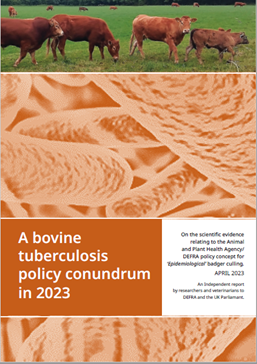
A new report on the possible future use of so called ‘epidemiological badger culling’ is being released to MPs and Parliament on 11th May 2023. Compiled over the last year by a group of independent experts, it looks closely at one specific element of the government’s bovine TB control policy proposals for English cattle herds; that regarding the role of badgers in bTB disease hotspots as they develop.
Government Policy in 2020 had suggested a move away from intensive mass badger culling, that by 2022 killed over 210,000 mostly healthy badgers in England since 2013. This huge programme of wildlife intervention has produced no demonstrable benefit to disease control in cattle, with the government silent on results since 2017.
Authored by experienced and independent researchers, veterinarians, and epidemiologists, it addresses DEFRA’s handling of the disease crisis, and why the 2020 “Next Steps” policy is likely to fail because of incorrect decision making and exaggerated claims made on the back of equivocal research results.
The report claims that the Animal and Plant Health Agency (APHA) and DEFRA, are failing in their duty to provide proper scientific approaches to vital aspects of the heavily publicly funded, long running bovineTB control crisis in England.
Specifically, it exposes the poor rationale behind aspects of the proposal which aims to implement systematic localized elimination in an area of all (100%) of badgers, an approach termed by DEFRA as ‘epidemiological badger culling’. This back-door approach to systematic removal of badgers from farmland where cattle have bTB, is already being trialed in a small number of counties and appears to be planned in more. But it is founded on evidence and beliefs that are not fit for purpose.
The 55 page report with 2 page summary, provides a catalogue of evidence on issues that the authors say have been consistently misrepresented by APHA and the Chief Veterinary Officer. It calls for an immediate rethink, scientifically robust planning and an end to supporting an ill-conceived policy with uncertain science and procedures.
The report is prepared in advance of an anticipated government consultation over its future policy to phase out badger culling.
Report Citation: Griffiths, L., Griffiths, M., Jones, B., Jones, M., Langton, T.E.S., Rendle, M., Torgerson, P. 2023. A bovine tuberculosis policy conundrum in 2023. On the scientific evidence relating to the Animal and Plant Health Agency/DEFRA policy concept for ‘Epidemiological’ badger culling. An Independent report by researchers and veterinarians to DEFRA and the UK Parliament. APRIL 2023.
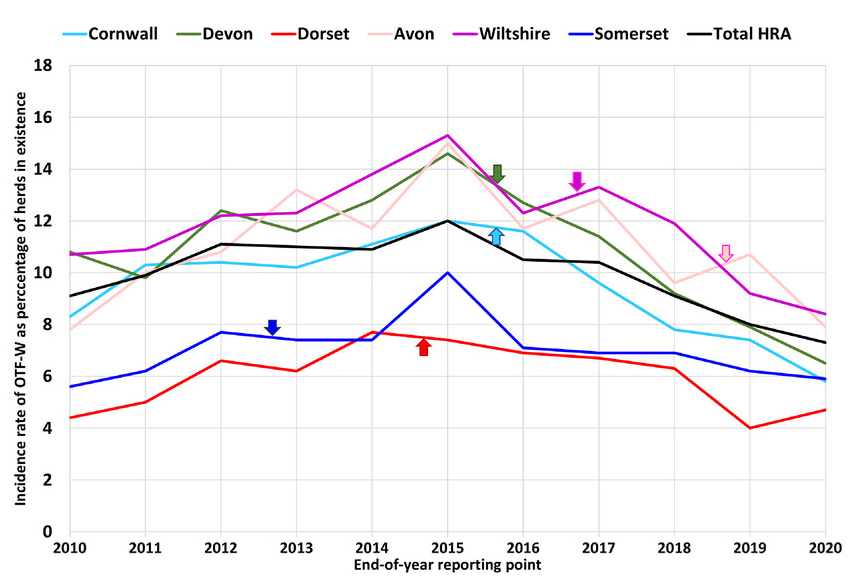
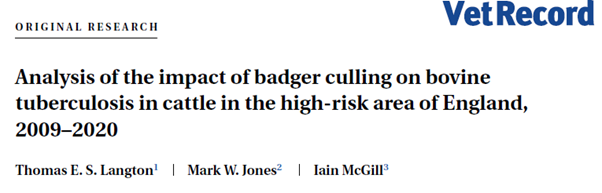
Since mid-March 2022, Defra has persisted with its claims regarding an independent scientific paper (1) that extensively analysed government data on herd bTB incidence and prevalence in the High Risk Area of England since 2010. The paper compares areas subject to badger culling with those that were not culled in each year of the controversial mass badger culls from 2013-2019.The paper concludes that badger culling has had no measurable benefit in bovine TB disease reduction, and Defra continue to claim that the paper is flawed.
Defra’s and Natural England’s position on this new analysis, including apparently that of the Defra chief scientist (CSA), Gideon Henderson and chief vet (CVO) Christine Middlemiss, seems to be based on their dislike of the statistical approach of the new paper, which differs from Defra’s traditional approach to badger cull evaluation.
Defra/APHA prefer to try to mimic the analytical methods of the Randomised Badger Culling Trial (RBCT). They take cull areas and compare them with different unculled areas, adjusting the data considerably to try to take account of the subtle or sometimes profound differences between compared areas. The new study took a different approach. This study looked at the same (or 97% of) herds over the years of study, so spatial differences were minimized. The analysis used data from herds when they were in unculled areas, and then again when they were in culled areas following their transition from one to the other. This simple approach, dictated by Defra secrecy over cull area locations, brings different strengths and requires less interference with the data. The approach enabled all the data available to be used, not just selected parts of it that might lead to skewed, inaccurate results and conclusions. Just look, for example, at the tangled caveats in the Downs paper from 2019 of just three culled areas and multiple unculled areas.
But Defra are very bold in their criticism : “the analysis was scientifically flawed. It manipulated data in a way that makes it impossible to see the actual effects of badger culling and therefore its conclusions are wrong.” Confident claims, but do they have merit?
Defra’s ‘inappropriate grouping’ claim
Defra’s main objection surrounds the issue of what they call ‘inappropriate grouping’ of data. This is the key point in the letter that they pressed the Veterinary Record journal to publish alongside the shortened printed version of the paper on 18th March. This was reported on in more detail here.
The problem in Defra’s claim goes beyond the calculation mistakes in their 18 March Vet Record graph, that they subsequently (in May) apologised for, retracted & replaced with results more similar to those in the new paper. Defra’s presented data shows the herd bTB incidence reducing dramatically in the first and second years from cull commencement. This is the same data as used in the new paper, so this is no surprise. But the point is, Defra say that you cannot group data from years one and two of culling with that from the third and later years because thelevel of decline in years one and two are too small, and this will remove all signs of effect. However, the Defra graphs do not show that the level of decline in years one and two in cull areas is small, and this is the contradiction that they refuse to talk about.
Similarly, the analysis presented by APHA staffer Colin Birch at the IVSEE16 conference in Nova Scotia, Canada earlier this month, (2) Figure 1, does not show that the level of decline in years one and two is small either. It showed sustained decline over 4 years, with a similar level of decline each year right from the start. Yet it provided no comparison of data from the 25% of the HRA that remains unculled. To the audience’s complaint, here, he quite wrongly tried to attribute these declines to badger culling.
Figure 1. Marginal effects on confirmed bTB incidence rate associated with duration of badger control. Error bars indicate 95% confidence intervals. From Birch abstract ISVEE 2022
So where did the ‘inappropriate grouping’ comment come from? Well, it is likely that Defra have fallen back on RBCT advice and the 2006 and 2007 (3,4) papers that presented the findings of 10 treatment-control area comparisons of small cull areas. These papers showed large variation in the estimated levels of decline in bTB herd incidence in culling areas, so much so that the confidence intervals (CI) on the presented graph figure 2A (Figure 2.) passed through 0 in most years.
Figure 2. Fig 2 (A) from Donnelly et al. 2007
Estimated average declines were 3.5% in year 1 and 12.8 % in year 2, with 39% in year 3. So, you can see that by using the RBCT as a prior reference source (this the point of reference used in Defra/APHA documents), there could be an expectation that there isn’t much disease reduction in years 1 and 2. However, while the drop may not have been projected to show significance until year 3, the decline trend should be present and visible by the end of year 2.
So looking again at Figure 1 (Birch 2022 abstract), government is now turning this on its head and claiming, in contradiction, that bTB incidence among cattle herds reduced by around 15% per year in each of the first two years of badger culling.
Defra’s unsupported point was also made by Cambridge vet James Wood on Radio 4 Farming Today on 19th March 2022, but it simply doesn’t stack up. Even if there was just a modest (say 8% average) annual benefit in years 1 and 2, it would still have shown up in the new paper analysis in comparison with unculled areas when using such a huge amount of data, as is possible using the 2016 onwards rolled-out HRA badger culls.
Ridiculously, Defra have previously claimed substantial benefit in years 1 and 2 from the post-2013 cull data, and used this as a basis for claiming badger culling was working. They did this spectacularly in 2017 with the APHA Brunton et al. paper (5) that suggested benefit 32% in Somerset, and 58% benefit in Gloucestershire in the first two years, and again in 2019 with the notorious and heavily caveated Downs et al. paper using data to-2017 (6), that was undone by the 2018 results (7), also published in the veterinary literature, with slightly more claimed benefit (Table 1 below).
Pilot cull Area 2013-2017
Brunton et al. 2017
Downs et al. 2019
Percent est. in Yrs 1 and 2
Gloucestershire 1
58%
66%
88%
Somerset 1
32%
37%
86%
Table 1. Claimed benefit from badger culling in Brunton et al (5) and Downs et al (6).
The Defra Minister and MP’s were told that badger culling was working based on this claimed year 1 and 2 benefit. They told parliament and the public in no uncertain terms that badger culling was working, so they can’t really go back on it now without losing face. James Wood also told Countryfile views that he thought the data showed badger culling was working based on the first two-years of pilot data. So, who is talking in riddles now?
The problem that Defra have, and it is why they have clammed up to the scientists and media, is that if Defra/the CSA/CVO were to communicate beyond the bold claims made in March in Vet Record and on the Defra media blog, they would lose the argument. Defra have written to the first author saying they are not prepared to discuss the matter. Caught, it seems, between their scientific advisors’ comments, legal undertakings to monitor efficacy and policy-mania to keep on badger culling in the face of failure. Even Natural England have gone as far as saying that the situation is unclear “Because these different control measures are being implemented simultaneously, it is difficult to determine the relative contribution each of them is making to disease reduction.”
Insufficient data points?
One argument Government have used to dismiss the validity of the new paper is that it has insufficient data points. While the new study does has few data points, each data point summarises a huge amount of data representing hundreds or thousands of herds, helping to obviate the kind of problems caused by the smaller data sets of APHA studies. The approach is equally or more valid. It did, after all, pass rigorous peer-review (4 reviewers including at least two epidemiological statistical specialists) in a leading veterinary journal.
Basically, Defra lost both arguments, rebutting the paper in short measure, and it is astonishing that CSA Henderson CVO Middlemiss were given this position to hold, let alone to defend. No wonder Middlemiss got muddled on Farming Today over it on 25 May. This problem is now many months old and Defra and Natural England have carried their unsubstantiated criticisms along to justify the licensing of further supplementary culling licences in May and intensive culling licenses from August. This means the killing of tens of thousands more largely healthy badgers over the next four years to add to the roughly 200,000 that have been slaughtered to date. This flies in the face of peer-reviewed science, against which Defra have failed to produce anything credible or comprehensive that is peer-reviewed.
At the Birdfair State of the Earth panel debate on 15th July of this year, the retired badger cull architect Prof Ian Boyd: Chief Scientific Adviser at Defra (2012-2019) commented: “Well, if badger culling isn’t working it shouldn’t be done, that’s absolutely clear. I think there is still an ‘if’ there, but I suspect that the evidence is suggesting it doesn’t work.”
And Prof David Macdonald at Oxford, who chaired the Natural England Scientific Advisory Committee for many years, and who called the Pilot culls an ‘epic fail’ has commented in Chapter 16 of his new Oxford University Press book ‘The Badgers of Wytham Woods’: “ it is hard to see how Middlemiss and Henderson land a knock-out punch on Langton et al’s analysis..”
There is nothing very dramatic or complicated here in Defra’s last stand. Defra has lost the scientific argument. They must surely now face abandoning the failed badger culling policy altogether. They really should talk openly about it.
References
1. Langton TES, Jones MW, McGill I. Analysis of the impact of badger culling on bovine tuberculosis in cattle in the high-risk area of England, 2009–2020. Vet Rec 2022; doi:10.1002/vetr.1384.
2. Birch, C. Prosser, A. and Downs S. An analysis of the impact of badger control on bovine tuberculosis in England. Abstract oral presentation to ISVEE16, Halifax, Nova Scotia, Canada. 2022.
3. Donnelly, C. A. et al. Positive and negative effects of widespread badger culling on tuberculosis in cattle. Nature 439, 843–846 (2006).
4. Donnelly CA, Wei G, Johnston WT, Cox DR, Woodroffe R, Bourne FJ, Cheeseman CL, Clifton-Hadley RS, Gettinby G, Gilks P, Jenkins HE, Le Fevre AM, McInerney JP, Morrison WI. Impacts of widespread badger culling on cattle tuberculosis: concluding analyses from a large-scale field trial. Int J Infect Dis. 2007 Jul;11(4):300-8. doi: 10.1016/j.ijid.2007.04.001. Epub 2007 Jun 12. PMID: 17566777.
5. Brunton LA, et al. Assessing the effects of the first 2 years of industry-led badger culling in England on the incidence of bovine tuberculosis in cattle in 2013–2015. Ecol Evol. 2017;7:7213–7230. doi: 10.1002/ece3.3254. – DOI – PMC – PubMed.
6. Downs S H, Prosser A, Ashton A, Ashfield S, Brunton L A, Brouwer A, et al. Assessing effects from four years of industry-led badger culling in England on the incidence of bovine tuberculosis in cattle, 2013–2017. 2019. Sci Rep. 2019; 9:14666. https://doi.org/10.1038/s41598-019-49957-6. Accessed 16 June 2021
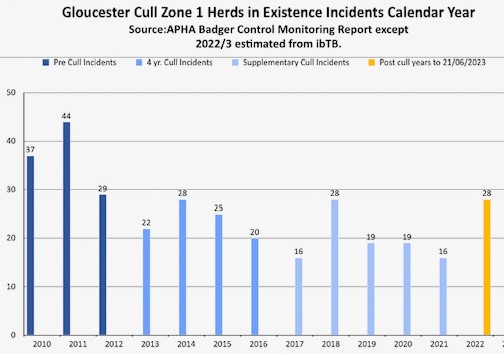
Over the last three years, the science base for badger culling has shrivelled away from ‘not very much’, to nothing. It has regressed from speculation that it might enable a modest annual reduction of bTB in cattle, to the reality that after 7 years of study, there is no measurable benefitwhencomparing herd breakdown rates in culled and unculled parts of the High Risk Area. It doesn’t work. This is one reason the government refuses to talk about it. Not only did the 2018 spike in bTB breakdowns in Gloucestershire show how unlikely it is that the killing of badgers is linked to the epidemiology of cattle breakdowns. It showed how cautiously the model-based claims of the Animal Plant and Health Agency (APHA) after 2 and then 4 years of culling should be considered. Subsequent detailed examination of all the government data this year in a peer reviewed paper (Langton et al) showed the badger culls to have failed.
Following a ridiculous three months of trying and failing to block and then rubbish the new scientific paper, Defra stopped communicating with the authors and enquiring journalists, leaving Natural England (NE) with the difficult decision of whether to continue issuing licences. The government response was to re-deploy Andrew Robertson from the government’s TB HUB information service in Exeter to Natural England in May of this year “because of a lack of expertise” inside the NE organisation. The outcome was that Natural England supported Defra’s position and issued yet more badger culling licences. Initially more Supplementary culling licences were approved by NE in May, this despite the fact that there was no benefit after 4 years to maintain for a further 5 years. Then in August, NE were somehow prepared to extend their belief in the killing of badgers and to continue culling badgers based on their own unpublished ‘secret’ science.
Instead of stopping culling as they should have done, NE have taken a nebulous stance on the science. It has refused to provide any written justification for its position, perpetuating its belief in the use of secrecy to prevent public scrutiny of their competence and decision making. The public have a right to see the rationale for their decisions, but this has been withheld. It is clear that NE have worked very very hard this year to facilitate continued issue of licences. They do this for a combination of reasons. They are likely fearful of contradicting Defra and APHA. Perhaps it would be too difficult to admit to failure on such a sensitive area.
Over the summer, NE Chairman Tony Juniper chose not to reply to communications, preferring to talk vaguely on public panels about NE not wanting culling and preferring vaccination. This summer he had a big chance to stop badger culling. He didn’t. He has now been in charge during the culling of most of the approximately 200,000 badgers. He and George Eustice have carried out what some call the near eradication of badgers over large parts of England.
NE eventually responded this week following a legal pre-action letter, sent in early October. They claimed that the death of the Queen and changes in government had prevented the licensing paperwork from being shared with those asking for it. These are embarrassing excuses for the lack of provision of legally required documents, on such a controversial subject of high public interest, and they reflect poorly on those responsible.
Information released late on Friday 28th October, showed 11 new cull areas, and the potential for tens of thousands more badgers to be killed. Over 30,000 or so could have already been shot over the last 8 weeks in a further sickening Natural England licenced ‘bloodfest’ of largely healthy badgers. One thing is certain, this is Natural England’s work. Natural England carry the torch for badger culling even if they say they are only following orders. As they have since 2012, when someone thought it would be a good idea for NE to carry it out and control it. They certainly have. It is the legacy of those involved with NE past and present, as much as anyone.
Dominic Dyer, chairing the State of the Earth evening session at Birdfair on 15th July this year, asked two of his assembled panel guests about badger culling. The first, Sir Iain Boyd, the former Chief Scientific Advisor (CSA) to Defra commented, beyond his usual emphasis that the problem is more with people than badgers, that he “suspected that the evidence is suggesting it doesn’t work”. And “if badger culling isn’t working it shouldn’t be done, that’s absolutely clear.” Presumably, a reference to the most recent peer reviewed science (here).
The second guest, Tony Juniper, currently chairman of Natural England, freshly reappointed for another 3 years, was asked about the ecological impact of changing ecosystems by removing most of a dominant species. His response was slightly less coherent. Knowing his staff had just issued more supplementary killing licences and were in the final stages of lining up licences for a further 40,000 mostly healthy badgers to be killed this and the following three autumns. He picked words carefully: “we did say that it wouldn’t be a good idea” and “Natural England’s advice was that it probably wouldn’t work and we should try other methods” and (not answering the question) “will it have an effect on protected sites and protected species?.. we are looking at that too.”
Not mentioned by him, Juniper’s hands were tied due to a legal case that would play out a fortnight later in the High Court, that turned into a spectacular environmental travesty (here), remining us just how far government and the judiciary are now leaning towards unsound, politically expedient policies. Briefly, Defra remade its improper decision not to look at impacts from badger culling, supported by Natural England, without telling the court or the claimant. It rubber stamped its do-nothing approach in a way that meant Defra and Natural England could carry on doing little or nothing, escaping justice via the back door. It was ‘too late and too expensive’ now to study and deal with the problem anyway, was their best position, and that was their final decision. Looking at it was all they were doing.
Natural England had promised the courts in 2018 that they were on the case, with a research programme that was kept secret. Secret, it turns out because the BTO analysis used to justify continued culling had mistakes in it, and so had to be held back for two years while culling continued and Natural England staff worked with BTO to get the work through peer review. More recent events in the sorry saga have been exposed thanks to wildlife stalwart Mark Avery (here) and his guest blogs by the main expert witness for the three Judicial Reviews, Dominic Woodfield (here). Dominic has, in his blogs and comments, unzipped the whole matter from start to finish and dealt with the response from BTO during the sordid passage of the work over its last five years. It is worth taking the time to read the new blog and those that went before, to get a firm understanding of how Natural England have obfuscated their statutory duty and worked hard at minimising effort to examine the problem, while at the same time helping badger cull companies with advice and support to find their cull targets.
Juniper is aware of this of course, and efforts to get funding from Defra to look at the issue may have been turned down. But he has another problem. He has a relationship with and has written a book with Prince Charles. Who is a known lobbiest for badger culling, with his ‘black spider’ letters urging Tony Blair to start culling, a notable royal intervention (here). There followed a concerted effort to neutralise badger culling opposition in mainstream wildlife ngos between 2008 and 2013. Now Prince is King, what will happen? The King faces the reality that the tenuous evidence of badger involvement in bTB in cattle fifteen years ago, then presented as strong evidence, remain tenuous. Critically, recently published research using all of the relevant government data suggests that badger culling since 2013 simply shows no sign at all of working. This is despite Defra’s attempt to use small selective amounts of data with over-elaborate variables to try to show that it does. Defra used their most senior staff CSA Gideon Henderson and Chief Vet Christine Middlemiss to try to rebut the new published research, but this has only made them look foolish. They published, then retracted flawed data (here) that showed huge benefits from badger culling in its first two years, while insisting in their rebuttal of the new analysis that there is little or no benefit to be had in the first 2 years. Leaving professional vets, scientists and commentators completely baffled. Juniper and Charles III now have a big opportunity to help put things right that have gone terribly wrong on their watch.
Most of all, with the BTO paper just published (behind a pay wall), there is a final piece of chicanery. There is no sign of the all-important last line of the conclusions in the papers introductory abstract. The latest BTO magazine simply says that a similar (to the new publication) minimal approach might be repeated. Yet in the BTO paper, the authors call for a landscape-scale quasi-experimental approach: “to provide stronger inference about the complex potential ecological effects of culling predators such as the badger”
More and more journals are making sure that study limitations are placed in scientific papers and their abstracts, partly a response to the science reproducibility crisis. What this all means is that Natural England corner-cut to address important questions about the effects of the ecological impact of culling. It now admits that the minimal approach it employed is inadequate, and points to the kind of study it now agrees should have been done. This, in truth, is confession of guilt when there is little chance of a retrial before thousands more badgers are gunned down.
Has Defra had enough of experts? Its own experts that is?
Last week The Daily Mail published a story (here) around the release of a Freedom of Information request (here). This FOI showed that the Deputy Director of the bovine TB Programme at Defra wrote to the journal Veterinary Record (VR) trying to influence the peer-review process of a new scientific analysis of badger cull data, Langton, Jones and McGill, (here), and largely failed.
The Mail story was published on Tuesday 30th August and names Eleanor Brown as the senior official who wrote to VR Editor Susanne Jarvis on 2nd March 2022, just a few weeks before the paper appeared in print. It laid down extensive criticisms aimed at the manuscript that they had been sent ahead of publication, where they stated that it was the VR Editorial Board’s (Headed by Lord Trees) decision as to whether to publish it or not. Defra thought it should not be published and made that very clear to a journal that extensively publishes government science.
The original Mail article implied that VR had been ‘forced’ to seek changes to the manuscript. The VR Editorial Board had in fact called a special meeting to discuss challenges to the paper, that Defra’s email in early March claimed was full of errors and flaws. However, the VR Editorial Board found that there was nothing wrong with the statistical work, which was found to be robust. These senior national and international veterinarians, with the VR staff, resting on the detailed reviews of no less than four peer reviewers decided that Defra’s accusations held little substance, and published the paper largely unaltered. The paper showed badger culling lacked any signs of working. Badger culling has not affected bTB herd breakdown in the High Risk Area of England since 2013.
The Daily Mail then republished the article the next day (31st August), removing the claim that Defra had ‘forced’ the Veterinary Record to make changes to the paper. The truth was that in order to proceed with publication, VR had required the authors to write-in Defra’s apparent intention to publish something in the future, using data it had kept secret, and describe it as a limitation to the study. Something that was dubious, but was made a condition of the paper not being blocked. So the Mail got it right in that there was an element of ‘watering down’ due to the Editorial Board meeting, but nothing that impacted the full force of the paper’s findings that showed that Defra’s badger culling policy had been a total failure.
Defra’s view that the analysis was flawed was therefore roundly rejected by over a dozen leading experts in the field. However, Defra had been invited to comment on the new paper for a short news piece to accompany the publication of Langton et al in the same edition of the journal. But this ‘comment’ somehow morphed into a full-page critique, fronted by the Chief Scientific Adviser Gideon Henderson and Chief Veterinary Officer Christine Middlemiss. This contained and expanded on the sentiments of Eleanor Brown’s email. It persisted with the claims that the paper was ‘flawed’. This was published under the guise of a ‘letter’ in the very same issue.
These highly unusual events then became farcical when commentators immediately recognised errors in Defra’s alternative view. But Defra then held out for six weeks before admitting that their letter was flawed. They then revised it. Saying it didn’t matter anyway because they were right and in effect, that the study, Vet Record editorial staff and the peer reviewers were all wrong (here). In response to last weeks Mail story, Defra even put out a defiant blog on 30 August repeating their original nonsense and unchecked views using small amounts of data for the unculled area comparison (here).
The 30 Aug Defra blog stated:
“As we had been invited to, we presented our findings to Vet Record to help inform its editorial decisions around publication of the paper, with the journal deciding to publish the study alongside a letter of response from the Chief Vet and Defra Chief Scientific Adviser. There was absolutely no attempt to make changes to the scientific research, as the Mail claims was the case.”
For some reason any comments made to this blog criticising Defra’s restatement of their flawed position were removed. Interesting.
So Defra now say that it never attempted to try to get changes made to the science. Yet it wanted to go over the head of the VR staff and peer-reviewers to the Editorial Board? And turned an invite for a news piece comment into a mini-paper that was wrong, dressed up as a letter.
Readers can be the judge of whether science was handled ethically in this instance. Defra say they made no attempt to make changes, yet they wrote to VR in very clear and emotive terms a few weeks before publication, and having been ignored, completed a hurried un-peer-reviewed missive that itself was full of error, ambiguity and secrecy. They were successful in getting the VR Editorial Board to require a smattering of changes stating that Defra had other ideas. Un peer-reviewed science of the future influencing peer-reviewed science of the present?
This actually all looks more than a bit dubious from the perspective of publishing ethics. It has to be asked, who is going to look into it? Having re-stated their views on their new blog, Defra have begun signing off new four-year intensive badger cull licences in 10 new cull areas this autumn, with 40,000 or so more badgers condemned. But Defra are wrong. They (wrongly) claim large benefits from badger culling in the first two years of culling, as they did in 2017, yet say this data cannot be used in the Langton et al analysis. And then they won’t talk about it and neither will Natural England’s statistical expert Peter Brotherton. Natural England as a whole have clammed up, presumably because Defra won’t explain their thinking to them either.
The Minister George Eustice owns the badger cull policy and is closely managing it. He must now be aware of what his staff have done. He may even be a part of it. They have painted themselves into a corner and gone to ground. Has he had enough of his experts yet? If he survives the reshuffle that is. If not, perhaps the dodgy legacy will be his, and a new Minister will get to grips with the ridiculous, unscientific yet defiant behaviour of Defra and its agencies on bovine TB and badger culling. As hundreds of badgers a day are shot for no good reason, the evidence clearly points to bad government and desperate measures. This policy of killing largely healthy, protected animals in a manner found cruel by the British Veterinary Association is out of control.
Today the Daily Mail lifts the lid on Defra’s attempts to interfere with scientific progress (here).
Defra were caught out by freedom of information (FOI) disclosures, leaning heavily on Veterinary Record journal staff, and using emotive language, over an accepted academic manuscript. This new scientific paper analysed the governments own bovine TB and badger culling data. It was published by independent researchers on 18th March (see here).
Defra lashed out in an extraordinary way at the authors, peer-reviewers and journal staff via a media blog and made half-baked attempts at manufacturing graphs using selective bits of (incorrectly calculated) data pushing what they wanted to see. They reached a new low level in efforts to keep badger culling going to prop up the failed policy. Their science and statistics is all over the place and they then refused to communicate over their embarrassment. Defra staff are now in bunker mentality with their advisers unable to help.
It should be all-over for badger culling – will the Defra, APHA and Natural England blinkers remain on, or will we see the change that the new science demands?
While Defra hold on to a now disproven view that badger culling is needed for control of bTB in cattle, there remain important omissions, contradictions & unanswered questions in their approach to the current management policy.
For a start, the management of Bovine TB (bTB) is still plagued by the inaccuracies of currently used tests and testing systems. Importantly, none of the primary tests currently used can identify the presence of live Mycobacteria which is core to the central dogma of bacterial diagnosis developed by Robert Koch, one of the main founders of modern bacteriology. He discovered the causative organisms of anthrax (1877), septicæmia, tuberculosis (1882) and cholera (1884). Koch’s dogma or principle, specifies that definitive diagnosis is dependent on the identification of the presence of the infectious organism.
There are major concerns about elements of the front-line bTB tuberculin skin-test. Firstly, it misses a substantial proportion of infected animals, thus allowing undetected infection to circulate in and between herds. Secondly, repeated injection with the tuberculin injection used for the skin test may potentially render an animal skin-test positive, despite there never having been any infection. Thirdly, the implementation of the skin-test is laborious and time-consuming, and requires multiple visits to the farm by a vet, hence while it creates work for vets, it is expensive.
In Human TB (hTB) the basic biology is similar. Recently, however, the human TB clinical fraternity have become increasingly concerned about the TB skin-test. In fact the concern has been such that the Centres for Disease Control (CDC), based in the US, now recommends the use of the TB blood tests (IGRAs), such as QFT-Plus (similar to Bovigam) over the TB skin test (TST) for most risk groups.
To illustrate the importance of this change of approach, clinical studies on the phage-based test ‘Actiphage’ have shown for the first time that live bacteria can be detected in the blood of people with incipient TB infection, including contacts of infected patients. This success was mirrored by the data produced by vet Dick Sibley at Gatcombe who used Actiphage and Bovigam (gamma interferon) to effectively eradicate bTB from the farm on two occasions. Those studies showed clearly that the best way to identify infected animals was the combined use of Bovigam and Actiphage, and not skin-testing. They indicated very strongly that the biggest problem in the eradication of bTB is the inability of skin-testing to identify infected carriers which actually maintain the infectious burden within the herd. They also imply that there is no significant involvement of external non-bovine hosts in the propagation of the disease.
So, the questions we would like to put to George Eustice and DEFRA are:
1) Why have you not implemented a controlled trial on the efficacy of different testing strategies for Bovine TB?
2) Why will you not take note of the human TB data? This clearly shows that identification of the live bacteria is the critical key to controlling this disease.
3) When will you recognise that all the data from both bovine and human TB indicates that there is no justifiable scientific rationale for the involvement of an external host to maintain persistent infection in the herd?
The UK’s Animal and Plant Agency statistician Colin Birch was roundly criticized for his presentation yesterday (12/08/22) at the 16th International Symposium of Veterinary Epidemiology and Economics (ISVEE 16) held at Halifax Convention Centre, Halifax Nova Scotia, Canada.
Birch presented data from badger killing zones in England in recent years, with no proper explanation as to why he had not also used data from unculled areas to compare. He claimed that a reported 50% reduction in bovine TB herd incidence in culled areas was due to badger culling.
The audience seemed less than convinced. At the end one question pointed out that it is not possible to attribute the reduction in bTB incidence to badger culling as the reduction in the unculled area had a similar trajectory. Cattle measures (Testing and movement controls) that were introduced prior to and over the same period (in both culled and unculled areas) would reduce incidence in the manner observed.
A further point was made from the audience that it looked like Birch and APHA were trying to make and promote ‘policy driven evidence’ to satisfy the ministry (Defra). Birch had no coherent response to this but said that he did not agree.
The unpublished manuscript by Birch and others is yet to be fully disclosed, but comes at a highly sensitive time for Defra and Minister George Eustice and Natural England Chairman, Tony Juniper and his scientific staff. They want to sign off the killing of another 40,000 largely healthy badgers from September of this year, despite the science suggesting that complete failure is the most likely outcome.
In March of this year, Defra issued flawed data (see here) in response to a detailed peer reviewed paper (see here) published in Veterinary Record which showed that badger culling in England since 2013 has failed. In a response to the paper, Defra produced a media outburst designed to undermine it, that claimed badger culling had little or no effect in the first two years, and therefore the analysis used was flawed. Observers have been left baffled and talking about government competence, since all the Defra data presented shows large drops in herd incidence over the first two years, suggesting that it is cattle measures that are responsible for these declines, and not culling.
Despite high public interest in this most controversial of policies, Defra have become tight-lipped on their home-made dilemma since March 2022, and defiantly issued more cull licences in June. But despite well and truly losing the science argument they still appear desperate to try to show some reason to prop up their policy and to enable them to keep killing badgers. This fell flat at today’s conference as the science community strongly questioned Defra’s handling of data.
A letter signed by 30 veterinary and environmental professionals has today been sent to the outgoing Prime Minster Boris Johnson and other members of the government calling for an immediate moratorium on badger culling in England. Those signing the letter include the three authors of a recently published peer-reviewed paper (read here) on the efficacy of the badger cull using government data.
A moratorium would allow time for independent scrutiny to establish the veracity of the independent scientific evidence as well as Defra’s claims, and to consider whether culling should be permanently ended as a result. It would also allow for a re-evaluation of the bovine TB eradication policy based on the latest scientific evidence rather than received wisdom that is decades out of date.
Green Party MP Caroline Lucas said:
“It couldn’t be clearer – badger culling simply doesn’t stop the spread of TB in cattle. Yet even when presented with this evidence, DEFRA has its fingers in its ears, and continues to kill at will. We need to see a moratorium to allow time for independent scrutiny of the evidence – which I have no doubt will reinforce the message that this cruel and counterproductive badger cull must come to an end.”
Tom Langton, the lead author of the independent study said:
“Defra have painted themselves into a ridiculous scientific corner and now simply refuse to discuss it. This is the sign of a government that has lost its grip and cannot accept that its own data now shows badger culling to be a cruel and ineffective failure. It’s Defra’s version of ‘Don’t look up!’.”
Veterinarian Dr Mark Jones, Head of Policy at Born Free and one of the co-authors of the scientific analysis, said:
“Huge numbers of badgers have been killed across vast swathes of the west of England over the past decade, ostensibly to control the spread of TB in cattle. However, in spite of Government claims, evidence that the culls are working is lacking. No further badgers should suffer and die for the sake of this failed policy. It’s time that badger culling was ended.”
The letter can be viewed here. The letter is featured in an article in The Guardian here.