The UK’s Animal and Plant Agency statistician Colin Birch was roundly criticized for his presentation yesterday (12/08/22) at the 16th International Symposium of Veterinary Epidemiology and Economics (ISVEE 16) held at Halifax Convention Centre, Halifax Nova Scotia, Canada.
Birch presented data from badger killing zones in England in recent years, with no proper explanation as to why he had not also used data from unculled areas to compare. He claimed that a reported 50% reduction in bovine TB herd incidence in culled areas was due to badger culling.
The audience seemed less than convinced. At the end one question pointed out that it is not possible to attribute the reduction in bTB incidence to badger culling as the reduction in the unculled area had a similar trajectory. Cattle measures (Testing and movement controls) that were introduced prior to and over the same period (in both culled and unculled areas) would reduce incidence in the manner observed.
A further point was made from the audience that it looked like Birch and APHA were trying to make and promote ‘policy driven evidence’ to satisfy the ministry (Defra). Birch had no coherent response to this but said that he did not agree.
The unpublished manuscript by Birch and others is yet to be fully disclosed, but comes at a highly sensitive time for Defra and Minister George Eustice and Natural England Chairman, Tony Juniper and his scientific staff. They want to sign off the killing of another 40,000 largely healthy badgers from September of this year, despite the science suggesting that complete failure is the most likely outcome.
In March of this year, Defra issued flawed data (see here) in response to a detailed peer reviewed paper (see here) published in Veterinary Record which showed that badger culling in England since 2013 has failed. In a response to the paper, Defra produced a media outburst designed to undermine it, that claimed badger culling had little or no effect in the first two years, and therefore the analysis used was flawed. Observers have been left baffled and talking about government competence, since all the Defra data presented shows large drops in herd incidence over the first two years, suggesting that it is cattle measures that are responsible for these declines, and not culling.
Despite high public interest in this most controversial of policies, Defra have become tight-lipped on their home-made dilemma since March 2022, and defiantly issued more cull licences in June. But despite well and truly losing the science argument they still appear desperate to try to show some reason to prop up their policy and to enable them to keep killing badgers. This fell flat at today’s conference as the science community strongly questioned Defra’s handling of data.
A letter signed by 30 veterinary and environmental professionals has today been sent to the outgoing Prime Minster Boris Johnson and other members of the government calling for an immediate moratorium on badger culling in England. Those signing the letter include the three authors of a recently published peer-reviewed paper (read here) on the efficacy of the badger cull using government data.
A moratorium would allow time for independent scrutiny to establish the veracity of the independent scientific evidence as well as Defra’s claims, and to consider whether culling should be permanently ended as a result. It would also allow for a re-evaluation of the bovine TB eradication policy based on the latest scientific evidence rather than received wisdom that is decades out of date.
Green Party MP Caroline Lucas said:
“It couldn’t be clearer – badger culling simply doesn’t stop the spread of TB in cattle. Yet even when presented with this evidence, DEFRA has its fingers in its ears, and continues to kill at will. We need to see a moratorium to allow time for independent scrutiny of the evidence – which I have no doubt will reinforce the message that this cruel and counterproductive badger cull must come to an end.”
Tom Langton, the lead author of the independent study said:
“Defra have painted themselves into a ridiculous scientific corner and now simply refuse to discuss it. This is the sign of a government that has lost its grip and cannot accept that its own data now shows badger culling to be a cruel and ineffective failure. It’s Defra’s version of ‘Don’t look up!’.”
Veterinarian Dr Mark Jones, Head of Policy at Born Free and one of the co-authors of the scientific analysis, said:
“Huge numbers of badgers have been killed across vast swathes of the west of England over the past decade, ostensibly to control the spread of TB in cattle. However, in spite of Government claims, evidence that the culls are working is lacking. No further badgers should suffer and die for the sake of this failed policy. It’s time that badger culling was ended.”
The letter can be viewed here. The letter is featured in an article in The Guardian here.
A new peer reviewed scientific analysis (Langton et al.) of the effects of the current badger cull was published in Veterinary Record on March 18th this year. Alongside the summary of the paper, Defra published a rebuttal of the science. There followed a conversation in Vet Record over the Langton et al. data versus the Defra data, and six weeks later Defra admitted that they’d got their data wrong. This is very worrying as it suggests that they have not been accurately monitoring the effects of culling as they should be, and as they assured a High Court Judge that they would back in 2018. Importantly, however, Defra maintained that although they had got their calculations wrong, this didn’t change their overall conclusion that the Langton et al. paper was ‘wrong’.
So what have Defra said is ‘wrong’ about the Langton et al. analysis? Let’s take a look……
Their main argument seems to be that data has been ‘inappropriately grouped’ because the impact of culling on cattle takes some time to appear. They claim this because Langton et al. add culled areas into the analysis in the years following commencement of culling. However, since Defra originally forecast an average annual 16% benefit from badger culling starting from year one, this is an appropriate approach. Indeed their own graph shows substantive declines in bTB herd breakdown incidence in year 1 and year 2. It is not clear how Defra’s argument can be valid on its own presentation. And even if there was some ‘dilution’ or ‘masking’ effect created by having early-year cull data in the analysis, if badger culling was, as claimed by Defra, ‘working’, it would still be possible to pick up a signal of any so-called ‘benefit’ from culling. But there is no detectable effect. None. Twenty-six statistical models failed to find any effect. Four independent peer reviewers, including epidemiological statistician specialists agreed and found the analyses robust.
OK, so actually there is nothing ‘flawed’ or ‘inappropriate’ or ‘wrong’ about the methodology as used in the paper, but Defra seem to carry on in denial, not wanting a conversation about it. How about the data analysis that Defra’s Christine Middlemiss and Gideon Henderson present in Vet Record, and which is also presented by Chief Vet Middlemiss in her 18th March blog?
Well, their graph starts in September 2015, not 2013 when the current badger culling policy began. Why might they do this? bTB had been rising in the High Risk Area for years, with the same trend being observed in nearly all areas. By starting their graph in 2015, Defra is obscuring the fact that bTB had already peaked before badger culling was rolled out to any extent, and has subsequently been declining in all areas. The Defra approach is called ‘selective use of data’, and it conceals the bigger picture of what is more likely happening, as shown in the published paper.
Again, Defra selected a subset of ‘never culled’ badger cull areas to compare with ‘culled’ areas. Why have they done this? Because if you compare ‘all’ the unculled areas with ‘all’ the culled areas, those 26 different statistical models used in Langton et al. fail to find any difference in levels of bTB between them. What is the difference between Defra’s ‘never culled’ data area & Langton et al.’s unculled data area? Well for a start Defra’s never culled area is very much smaller than Langton et al’s unculled area (see figure), about 30% of it in fact. Defra are are comparing only the blue (unculled) and red (culled) area data, but none of the green unculled area data; all area data were used in the Langton et al. analysis. The weakness of Defra’s analysis is their use of a smaller dataset. This could potentially exaggerate any difference between the compared areas. Again, Defra is selectively using data and adding uncertainty to claim a benefit, when impartial analysis using all suitable and available data shows there to be none. Defra’s approach is arguably less appropriate than that of Langton et al.. And of course their analysis is not peer reviewed, i.e. properly checked by independent experts. It is disappointing to see it being published.
What Defra are doing is picking pieces of data from areas of their choosing, using data from years of their choosing, holding them up, and saying, ‘look, we can see a difference’. It’s simply not acceptable to try to criticize a piece of peer-reviewed science like this, using hastily cobbled together snippets, to get your calculations wrong, and still claim that you are right.
What Middlemiss, Henderson and a few paid Defra contractors seem unable to accept, is that the analysis in Langton et al. points very convincingly to cattle testing initiating a reduction in bTB in Englands High Risk Area. Of all the statistical models used in Langton et al., it is the the one in which the cull is excluded that gave the greatest support i.e. a model that did not include culling as a covariate. So without the cull as an effect in the decline in bTB rates, it is cattle measures that are likely to be the driver and this is the best scientific evidence of that to-date.
There is a Crowd Fund for the upcoming Judicial Review Appeal of the ‘ecological impacts of badger culling’ case. You can donate to help cover essential costs here:
In March 2022 the Chief Veterinary Officer (CVO) Christine Middlemiss & Chief Scientific Advisor (CSA) Gideon Henderson joined Defra Media Centre in attacking a peer-reviewed, freshly published scientific paper on bovine TB control (Langton et al.), stating that they thought it was flawed, and had ‘inappropriate’ analysis, see here.
The graph the CVO & CSA produced (top right) looked odd, and the authors of the original paper immediately suspected an error in the data, and wrote to Defra with an enquiry to this effect. In addition, much of their written rebuttal seemed invalid. Further, the CVO wrote a personal blog highlighting her criticisms of the new paper. The blog then received a number of posted comments from external observers and academics which reiterated the papers’ authors’ concerns about potential errors in Defra’s analysis and incorrect conclusions. A response to the CVO & CSA from the authors of the paper was printed in Vet Record on 02 April, see here.
It took more than six weeks before Defra admitted that it had got it wrong and published a new graph of data (above, bottom right). But they maintained that this did not change their overall conclusions about the new paper; basically that it was ‘wrong’. They did not respond to the rebuttal arguments that the authors put forward in the 02 April issue of the journal Veterinary Record. On this there is still strange silence.
The authors of the paper had a further letter published in Vet Record on May 21st responding to Defra’s admission of data errors and their replacement graph. You can read this here.
This week, CVO Christine Middlemiss made a small adjustment to her blog, but did not change her faulty graph. She added some wording to the following paragraph (in bold).
“Our analysis indicates a clear reduction in OTFw cattle breakdowns, relative to unculled areas, in culled areas from cull year 2 onwards (Fig 1). For example, TB incidence in the areas where culling started in 2016 has dropped from 17.2 OTFw breakdowns per 100 herd years at risk in 2016/17, to 8.7 in 2019/20.
Similarly in the areas where culling started in 2017 it has dropped from 15.3 in 2017/18 to 8.4 in 2019/20.
In contrast, in the parts of the high-risk area (HRA) where no culling took place, incidence has only fluctuated slightly from year to year, from 10.9 in 2015/16 rising to 12.8 in 2016/17 before returning to 10.9 in 2019/20.”
It is a shame that the CVO does not seem to have grasped that the first bar in the graph represents the first year data after culling and not pre-cull incidence. Incidence levels before culling began are missed off, and these better shows the pattern of change in the first two years that they focus on.
The CVO & CSA’s main criticism of the new paper is that (they imply) bTB does not come down enough in the first two years for those years to be grouped with later years of culling. Looking at their graph, this is clearly not the case and the CVO and CSA’s position is a paradox and nonsense. There is a drop in culled and unculled areas if you examine all the culled and unculled data, and not just a sample of unculled (never-culled) area. The steady decline in incidence, as shown in the Langton, Jones and McGill paper, is attributable to cattle testing and movement control measures. Defra’s attempt to show otherwise falls at the first hurdle. It is something Middlemiss and Henderson seem reluctant to address. It is understood that Defra intend to ignore their own faulty response, and endorse an APHA study at a disease conference in July in Canada as justification to carry on culling in September.
Christine Middlesmiss doubled down on her position in an interview on Farming Today on 26th May (the focus of which was Defra’s badger vaccination licensing scheme), using very strong language and stating that in the Langton, Jones and McGill paper, “the whole methodology was wrong and so the conclusion was wrong.” Again, she claimed that the authors had “not used a robust methodology to examine and assess it and therefore the conclusions are wrong, they’re not scientifically valid.”
This is a bold claim about a rigorously peer reviewed paper in a leading scientific journal, and one that it could be said she should be able to clearly and concisely articulate in a debate, or at least to the authors. It is not good enough for the CVO to just claim, as she did in her interview, that “it is complex“.
Further she said “we believe that culling is effective“, apparently relying on faith rather than understanding of published science. She must be able to explain her reasoning for dismissal of peer reviewed science. She also said that “It’s not absolutely my decision to release it [the data]“, implying political interference? The authors are still waiting for a response to their April invitation to discuss the CVO’s criticism with her.
You can listen to the CVO’s interview on Farming Today, available here.
The CVO & the CSA must look again and accept the findings of the new robust peer-reviewed research. Prevailing science shows the current badger culling policy to have failed, with no detectable impact from it on the incidence of bovine TB in cattle herds in the High Risk Area. The 29 Supplementary Badger Culling licences authorised this Wednesday were issued on the back of a government veterinary service in denial.
Middlemiss and Henderson say sorry for getting it wrong
As previously blogged on 18th March here, the respected journal Veterinary Record published a new scientific appraisal of the effect of badger culling on bovine tuberculosis (bTB) in the High Risk Area of England using government data collected from farmers and vets for over a decade. This extensively peer reviewed paper is available open access online, in full here. The paper concluded that badger culling has not been associated with reductions in bovine TB (bTB) incidence or prevalence among cattle herds.
Alongside a one-page summary of the paper in the Vet Record print edition, the Chief Veterinary Officer (CVO) Christine Middlemiss and Chief Scientific Adviser (CSA) Gideon Henderson published an un peer-reviewed letter rebutting the paper’s main findings. They produced their ‘alternative analysis’ in the form of a graph, and claimed it showed that badger culling was ‘working’ in reducing bTB in cattle. The graph indicated very rapid declines in bTB in culled areas following the commencement of culling, with little change in unculled areas. The CVO Christine Middlemiss also posted a blog on the Defra website using the same graph.
The graph could not be reconciled with publicly available data. There followed repeated requests for Defra to supply the data and methodology, but these were not met. Then last week, six weeks after publication, Middlemiss and Henderson sent an email to the authors of the original paper stating:
“Following your recent correspondence about how incidence in unculled area was calculated we have re-examined our analyses and discovered an error we wish to bring to your attention. The incidence in the area unculled throughout the period was calculated incorrectly. The incidence in cull areas is unchanged. We attach a corrected graph, with the corresponding data and workings as previously requested. We apologise for this error..”
A new graph was provided (see below). After further requests and delay, we have data from Defra to allow us to reproduce their corrected graph but not to check its origination. Defra’s original published graph shows bTB herd incidence higher in unculled areas in four of the five years, while in the new one it sits at the same levels as in culled areas.
As previously, Defra are still disregarding huge areas of unculled land in their blue-bar ‘never culled’ areas, which is problematic. Notably, however, the error bars between ‘culled’ and ‘never culled’ overlap more extensively, so the difference between the two is unclear. It seems that Defra’s corrected calculations corroborate the findings in the Langton et al., and that there has indeed been no significant impact from badger culling on bTB incidence among cattle herds.
Defra’s graphs from their 19th March letter and 5th May email:
19th March (withdrawn): Unculled incidence is higher than culled in 4 of the 5 years.5th May: Now incidence levels in unculled areas are shown well within same levels as culled areas.
Defra’s “never culled” areas are likely to include significant land areas where bTB is less of an issue, with landowners having a lower incentive to coordinate a cull, whilst the “waiting to be culled” portion of the unculled area will have significant areas where bTB is a major problem. Defra is engineering a highly selective use of the available data. It adds up to a misleading picture that is bringing Defra into disrepute. Without access to their full data source, it is not possible to fully understand their rationale.
Further, when you don’t limit the data as Middlemiss and Henderson did, and add “all culled areas” bars (green), and include 2013/14 and 2014/15 (see below), it shows the true extent of decline of bTB incidence in unculled areas that mirrors culled areas.
Revised Defra data with Langton et al’s unculled green bars
The 5th May ‘apology’ email from Middlesmiss and Henderson maintains that “this does not change the overall argument in the letter”, yet over six weeks on, they have failed to address a response by the authors to this criticism (published in Vet Record on 2nd April). This response shows that their main argument on ‘incorrect grouping’ of data does not undermine the peer-reviewed statistical analysis.
Specifically, Middlemiss and Henderson claimed that using data from the first two years of culling ‘masks’ any overall effect from badger culling, making it ‘impossible to see’. But Defra’s counter argument rests upon a steep decline in herd incidence over those first two years! Defra’s argument falls and the answer is that taking all the data, herd breakdowns reduce in culled and unculled areas at similar rates, due to cattle measures both before and after badger culling is rolled out.
So, the senior Defra scientists have no answer, and continue to use delaying tactics, while still providing only limited access to the available data that might enable independent researchers to assess their new graph. This is shocking and does not serve the public interest. Cattle-based measures implemented from 2010, and particularly the introduction of the annual tuberculin skin (SICCT) test have been responsible for the slowing, levelling, peaking and decrease in bovine TB in cattle in the High Risk Area (HRA) of England during the study period, before badger culling was rolled out in 2016.
Last week, the authors of the badger culling paper, Tom Langton, Mark Jones and Iain McGill wrote to George Eustice (read here) about the continuing fiasco and asking for badger culling to be suspended and for additional clarification and dialogue.
This is what all stakeholders and the public deserve. Clear, open government responding to the facts in an honest and professional way. No more delay, secrecy, and avoidance of the real issues. It is time things changed.
On Friday 20th May, the paper’s authors response to Defra’s apology and clarification was published in Vet Record. You can read this here:
Farming Today featured the debate around Defra’s data miscalculation on 20th May; you can listenhere from 7:18 minutes in.
Book Review: A History of Uncertainty – Bovine Tuberculosis in Britain 1850 to the Present, Peter J Atkins, 2016, Winchester University Press (Link to the online chapters of this book (free subscription required) here.)
By Tom Langton
Back in 2016, having just begun a detailed examination of the Randomised Badger Culling Trial (RBCT) (1), this book escaped my attention. Now with a tatty ex-library copy from ebay, its value and place is clearer. As with the 2019 review by Angela Cassidy (2), it is I believe a substantial contribution to the understanding of the English bovine TB (bTB) epidemic and control policy in the period since ‘badger blame’ emerged in the 1970s.
Peter Atkins, has been a prolific food and drink geographer and historian at Durham University, including inevitably, the disease-related issues. Much of the book is a detailed account of the technical and political context surrounding livestock management and milk production, including pasteurization since 1850, as a threat to human health. This is a compelling blend of what happened and why, regarding the once extremely debilitating and widely lethal bovine TB threat to human health in the UK.
Atkins book was published before the announcement of the 2016 badger cull roll out, which Atkins misjudged as unlikely to happen. Despite this, insight generally seems well evidenced and often convincing, and the book is especially worth reading in terms of what has unfolded since 2016.
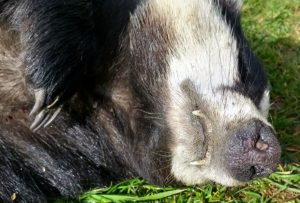
Don’t be put off by the cover of the book, that shows nose to nose proximity between a tame badger and a cow, in an unlikely day-time event. This is, according to research done before and since publication, a rare event even at night, which is when badgers are most active above ground. In fact, it is one of a group of photos that has unintentionally proliferated misunderstanding of the transmission of bovine TB from badger to cattle.
Although bovine TB and badgers occupies only the last quarter of the book (chapters 12-15), it manages to get through a good amount of epidemiological practicalities at pace, and provides bouts of eloquent summary. There is a useful collection of around 800 author-indexed references at the back of the book, several of them obscure, with handy library reference numbers too.
Spat between the ISG’s John Bourne and CSA David King
Chapter 12 on epidemiological understanding provides some useful detail on factors such as cattle herd density changes over time, government expenditure on disease control and potential infection pathways. Its thoroughness extends, at least to some extent, to referencing international examples and molecular consideration of spoligotype distribution. Chapter 13 is a rapid road trip from the period where bTB was found in badgers in 1971 in Gloucestershire, through the uncertainties of the badger-cattle disease relationship and infection of badgers by cattle. There is good descriptive summary, albeit with historical account of certain research findings as fact, rather than placed in any measured scientific context of the strength of findings. This is not a criticism as this was not a scientific appraisal.
There is a short history of badger culling from 1971, a rapid summary of the RBCT and the Independent Scientific Group 2007 report and of David King: the government chief scientific advisor’s critique of it. Plus, the spat between the Independent Scientific Groups’s John Bourne and King, that followed. Of some interest is the report that in 2007, it was the Labour government, under Gordon Brown and the MAFF-centric Lord Rooker, that laid the foundations for mass badger culling, even if there followed a delay by Hilary Benn until Labour lost the election to the coalition government in May 2010. There is some basic material on badger cull opposition and the period leading up to the culls starting, but nothing comprehensive. The threats from uncertainty and risk, the focus of the book, are well measured at appropriate points in the narrative. While several of the uncertainties are better understood due to research in recent years, the text for the most part stands the test of time well and is a good general foundation for the student.
Civil Service prone to massive policy mistakes and blundering?
Chapter 14 is likewise an admirable summary for the time of bTB testing protocols, and test accuracy. Examining what is termed the ‘recrudescence’ of the disease in England and Wales since its near eradication in the 1960s, it touches on important disease eradication cost-benefit issues and a more condensed history of disease administration, with even a brief sortie into cattle and badger vaccination.
But perhaps what is most interesting of all, is saved to the final chapter 15: ‘Is uncertainty the future?’. As the writer puts it, ‘what are the lessons the historical geography of bTB has for us?’ There then follows, as a warmup, a look at complexities of some of the spatial questions in bTB epidemiology, raised earlier in Atkins and Robinson (2013) (3) and more recently reinforced by findings from Whole Genome Sequencing. There is an amount of conjecture over ‘scenarios’ that to the historian may seem like useful wondering, but to the scientist perhaps are rather speculative. Maybe a bit of original conjecture is okay, but it stands out a bit in contrast to the bulk of careful documentary.
Then, for me the book turns even more compelling. It addresses the question of why the bTB response has been so sluggish and ineffective, and what is framed as the ‘grotesque cost’ of dealing with diseases of the intensive cattle industry: BSE, Foot and Mouth and bovine TB over the last decades. It looks at the punitive demise of MAFF after Foot and Mouth, and how the British Civil Service seems somehow prone to massive policy mistakes and blunders. Should, asks Atkins, bTB handling by Westminster be added to the ‘hall of infamy’ of policy disasters? But then ‘no’ comes the answer, with a slightly unconvincing defence. His forgiveness is founded on his perception of complexity and uncertainty in the science.
Bang on cue, a sub-section is set up, that chimes with recent discussions over England’s covid-19 early response management entitled ‘A rule of experts?’. The building of policy-lead science (4) to address difficult questions is laid out, leading to the introduction of the concept of dealing with complex and politically tangled issues, framed as ‘wicked’. Based partly on the fact that the problem is dire, unforgiving, labelled as unsolvable and hence apparently justifying unconventional resolution. So ‘Yes Minster’ style consequentialism – where the ‘ends justify the means’: your often ‘tribal’ (5) bad behaviour is excused, and where whatever you decide, you become blameless. Does this government approach sound familiar?
Wickedness unveiled
The last few pages of the book, ‘Bovine TB: a wicked problem?’ may both delight and annoy. They delve into the philosophy of addressing problems that are rated so unbalanced, complex, and frustrated, that the strategy is to manage them, based on continued uncertainty over long periods of time. So bTB is allocated to ‘wicked’ philosophy (6), something that the very senior government officials and scientists may have latched on to at the start of culling as interest in its use began to grow (7). Meaning, that the uncertain outcome of badger culling wasn’t an important issue; it didn’t have to ‘work’ if it induced the livestock industry to accept tougher disease eradication measures that they were resisting. Such approaches are also nicely framed as a ‘clumsy solutions’. All government scientists and vets had to do, whether in the know or not, was roughly comply with a top-down ‘yes, it is the badgers’, undertake a bit of low inference analysis, then maintain ‘you will never actually know directly how much badger culling has contributed to disease control’ and ‘we are going to use every tool in the box’. This of course nullifies a range of professional and ethical pledges, and may be unlawful. But hey, this is a ‘wicked’ problem, these are different times and so anything goes? Those who have said badger culling is criminal may actually have a point?
One must ask who was ‘in’ on the badger cull wickedness, who fixed it, made it happen and who drove the car? It is getting easier to see now. Anecdotally, government staff will apparently not deny it in private. This has been clear from multiple sources since Atkins book. But outwardly, in-post, their job comes first and they will follow the tribal line. This helps explain why Defra have reacted so ferociously (and clumsily) to the now emerging data on the badger culls (8) that shows them for what they are; ineffective. The problem must and needs long-term to remain ‘wicked’ for the emperor’s clothes to remain visible. But Environment Secretary Minister George Eustice has lost cull architects Ian Boyd and Nigel Gibbens, and those replacing them may not have been told and thus have greater exposure.
Atkins almost spoils it at the last, as Angela Cassidy did in her book in 2019. He had already come up with his own esoteric home-brew idea that badgers pose more of a risk at certain densities. He points at uncertainty in the epidemiology and the pathogenesis, but not to any deficit in ‘formal sector expertise’, which is a bit over-simplified. He denies ‘selfish individual motives or special interests’ which also looks a tad naïve, given the strength of influence of commerce in the mix. Atkins suggests no one is to blame, or that the blame is evenly spread, which is the diplomatic nice story, but one cannot help feeling that in doing so, like Cassidy he drops into the ‘sticky trap’ of badgers and bTB (9).
Of course, scientific evaluation is not Atkins forte, and there is failure to balance scientific findings according to their limitations. BTB is a scientific problem and you can see as he cites and runs through much of the key relevant literature, that he is not pausing on the uncertainty and hindsight problems within them.
Despite this, Atkins logically foresees the time of effective use of cattle measures that were starting to bite in the High Risk Area as he finished this book, and that they need further tightening with better testing and/or cattle vaccination, to finish the job. Such disease control achievement however, is not the consequence of any ‘wicked’ approach. It is simply what would have happened with strong leadership and without badger culling. And, with all due credit, Atkins also rightly concludes that badgers are likely to be seen as a distraction to the bTB problem when all is said and done in years to come. Again, this book was published before the announcement of the 2016 badger cull roll-out and his last page makes salutary reading, as he was unaware of the mass butchering of largely completely healthy badgers that would immediately follow, and that should hopefully soon be abandoned.
This is a great ending if you are concerned by the repeating car wrecks of government veterinary epidemiology when addressing livestock disease control in England. And how the manipulation of logic and science for expedient high risk approaches, can be endorsed and nurtured in the tribal institutions in public service, given a few wicked people pulling the strings.
A link to the online chapters of this book (free subscription required) is available here.
References
Bourne J, Donnelly C, Cox D, Gettinby G, Mcinerney J, Morrisson I, et al. Bovine TB: the scientific evidence. A science base for a sustainable policy to control TB in cattle. Final report of the Independent Scientific Group on Cattle TB presented to the Secretary of State for Environment, Food and Rural Affairs the Rt Hon David Miliband MP; 2007.
Atkins, P.J. and Robinson, P.A. (2013) ‘Bovine tuberculosis and badgers in Britain : relevance of the past.’, Epidemiology and infection., 141 (Special issue 7). pp. 1437-1444.
Kao, R. Simulating the impact of badger culling on bovine tuberculosis in cattle. Vet Record 176 February 18 2012. “An underlying problem in this debate is the contrast between the burdens of proof demanded by the scientific and policy constituencies. The burden of scientific proof requires near certainty in outcome; the classic limit for scientific confidence is that 19 times out of 20, a repeated experiment will produce a stated result (ie, the result is within the 95 per cent confidence interval). Policy, however, must balance the efficacy of a potential measure with social, economic and political requirements, and in the event that a decision is to be made, it is made only when the balance of probabilities is in its favour. Thus, there is an inherent paradox in the need to take statistically rigorous, scientifically sophisticated recommendations and view them through the relatively fuzzy lens of sociopolitical realities.”
See Pellezzoni I. 2014 Technoscienza 5,2,73-91 and a raft of associated ideas discussed in the Atkins book and elsewhere.
Badger culling emerged from scientific endorsement but there was no real link between a large experiment with equivocal results and its real-time application. Culling badgers was simply ‘Bourne’s carrot’ using Kao’s (3) acceptance that an arguable balance of probability it might work (see (3) above) was sufficient.
Thomas E. S. Langton, Mark W. Jones, Iain McGill, 2022. Analysis of the impact of badger culling on bovine tuberculosis in cattle in the high-risk area of England, 2009–2020 Veterinary Record Vol 190 Issue 6. 18 March 2022
A new article for BBC Wildlife Magazine by James Fair takes a look at newly published peer reviewed research that concludes that the badger cull isn’t working. It’s worth a read because it puts the new analysis into the context of the historical background of bTB and the previous analyses of the results of badger culling.
It is of note that the conclusions of the Independent Scientific Group (ISG) in 2007 are mirrored by the conclusions of the latest study;
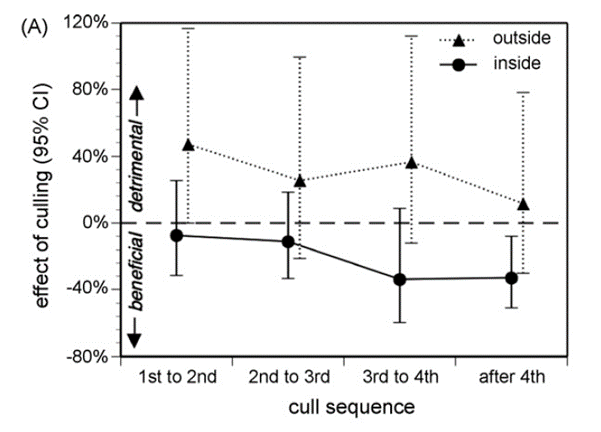
ISG: “After careful consideration of all the RBCT and other data, including an economic assessment, we conclude that badger culling cannot meaningfully contribute to the future control of cattle TB in Britain,”
And
Langton, Jones and McGill 2022: “This examination of government data obtained over a wide area and a long time period failed to identify a meaningful effect of badger culling on bTB in English cattle herds.”
Despite this confirmation of the expected & predictable results of nine years of badger culling, Defra (Chief Vet & Chief Scientific Adviser) have kicked back strongly with accusations of partiality on the part of the authors. This is somewhat ironic as (nearly) all published English bovine TB science to-date has been published by Defra or their funded contractors. Commentary on the paper via the Science Media Centre was supplied by two recipients of Defra contracts who are or have been heavily engaged in bTB policy.
The paper’s authors are still waiting for a reply to their request for an explanation of how Defra manipulated data in their un-peer reviewed rebuttal analysis letter, published in Vet Record, which claims to show culling does reduce bTB in cattle.
A recent scientific paper in Veterinary Record (1) by independent researchers Tom Langton, Mark Jones and Iain McGill, showing the effects of badger culls on bovine TB herd breakdowns over the last decade, has been met by criticism from officials at the top of Defra. There are accusations that it is ‘flawed’, and in the Daily Telegraph, even of data ‘rigging’ . You can view a 3 minute video of the main findings here.
Further details on the origin and contents of the paper are discussed in a 40-minute Off the Leash interview by Charlie Moores with two of the authors Tom Langton and Mark Jones, here.
Many badger campaigners will know Mary Barton, aka Betty Badger, who stands up for badgers outside Defra offices each Thursday, and has done for many years. On Thursday 17th March, she was granted a meeting in person with Environment Secretary George Eustice. He told Mary that he thought the study was ‘flawed’. Then on 18th March, Defra put out a dramatic press statement, criticizing the content & motivation of those involved in writing, reviewing, and publishing the paper (2) :
“This paper has been produced to fit a clear campaign agenda and manipulates data in a way that makes it impossible to see the actual effects of badger culling on reducing TB rates. It is disappointing to see it published in a scientific journal.”
and
“Experienced scientists from the Government’s Animal and Plant Health Agency have reviewed the report and found its analysis is scientifically flawed. It has manipulated the data in a way that makes it hard to understand the actual effects of badger culling and therefore its conclusions are wrong. Today, the Chief Veterinary Officer, Christine Middlemiss, and Chief Scientific Adviser, Gideon Henderson, have also published a letter in Vet Record, which rebuts the report’s claims. The CVO has also written a blog about this.”
Which stated (3):
“We do not believe the scientific methodology used is credible as the analysis has been carried out in an unusual manner ”
These are confident words from the chief vet, informed no doubt by James McCormack (Head of Science Advice to Defra TB policy) and Eleanor Brown (Defra’s Veterinary Head for TB Policy Advice) to try to prevent acceptance of what are the plain and simple findings from Defra’s own data. The new analysis has been extensively checked using appropriate models, peer-reviewed by 4 reviewers, and accepted as a solid piece of research. In truth the 2021 badger culls should have been put on hold in June of that year because the basic findings were clear then and Defra knew about them.
However, the Defra Chief Scientific Advisor and CVO claimed in a letter to Vet Record on the day of publication (4) that “This analysis has been carried out in a manner that masks the effect of culling by incorrectly grouping data.”
Defra’s alternative analysis, shown above, has done something strange to diminish ‘unculled’ area data, that is not explained, yet which appears to undo their own argument. The letter states that the ‘impact of culling on cattle outbreaks takes some time to appear’ while showing steep decline in bTB in the first two years of culling. Oops!
All scientific studies have limitations and none are 100% correct. What Defra are doing in their letter is adopting a pro-cull narrative to promote their policy publicly, with an un-peer reviewed analysis. They are avoiding the sharp reality of what their data is really telling them, and George Eustice and the government should be very concerned about this.
Defra have defended their pro-cull policy in Parliament and in the High Court using a government study from 2019 that uses very small amounts of data (Downs et al. 2019 (5)), wrongly, as ‘proof’ that badger culling ‘works’. That paper in fact admits that there are enormous limitations to its conclusions. The position that ‘culling works’, however, has been widely adopted by the Minister, MPs, the NFU and farming stakeholders.
It’s in the herd: cattle measures are the answer
Cow undergoing SICCT test
Defra have dismissed in a short soundbite, one of the most interesting findings of the published paper: the disease slowing, peaking and declining between 2011 and 2016 across the HRA counties, and before badger culling began in all but one area. Defra want to adjust the data for confounding variables. Such adjustment is something that only Defra can do, as they alone have access to this ‘secret’ data. But adjustments are hardly likely to substantially change the conclusions, when such a huge dataset has been used in the analysis (over 20,000 herd a year). Mention has been made of changes in badger cull buffer areas and badger population numbers, but the strength and validity of that data is questionable and presently obscure.
The Defra letter is particularly disappointing, given that Defra/APHA should have been using data to closely monitor and inform the public on the effects of bTB interventions and to ‘adapt and learn’ from their analysis. As they intimated would be the case in a Judicial Review of culling in the High Court in 2018, and as the judgement anticipated. And to encourage and inform those involved in the grueling cattle testing effort. Shouldn’t the public, who are after all paying for all of this, demand that too? Ask a simple question: why didn’t Defra do an analysis with the large data set they had available in 2019 and show the results? Was it because it showed that bTB was peaking and falling in both culled and unculled areas, well before badger culling was rolled out?
But that would mean admitting that cattle measures are the key ‘tool in the box’ to bTB control and need to be extended. BTB decline since 2015 has averaged around 5% per year in the HRA, very similar to the picture in Wales where badgers are not culled and also in Republic of Ireland (RoI). Badger culling is now being phased out in RoI, with long term use of annual SICCT and gamma testing, and with bTB OTFW incidence no lower than around 4%, due to the limitations of the SICCT test. International evidence points to cattle measures alone being the solution, as predicted by experts for over 20 years.
The answers are all here. BTB should keep coming down in the English HRA if it follows the RoI trend over the next 3-5 years. If modern PCR testing is applied, it could be dealt with well before 2030. If the will is there. The Edge area crisis is another matter, but could be turned around too with correct thinking and the right interventions.
Other specialist comment:
Prof Paul Torgerson from the Section of Veterinary Epidemiology at the Vetsuisse Faculty of the University of Zurich wrote an opinion editorial for Vet Record on 19th March (6) offering insights on why badger culling doesn’t work, as predicted by the government researchers conducting the Randomised Badger Culling Trial back in 2007.
The Defra and the Middlemiss/Henderson arguments have been more than dented.The authors of the new analysis have responded in the Veterinary Record (2nd April) letters pages (7), saying that Defra’s criticism of the paper is baseless, and their attempt to show alternative science lacks explanation in the way they have handled the data. Defra have discounted around half of the data and the figures they use do not match figures from the reference material. There is also a dead end Link. This could be interpreted as ‘data manipulation’ to try to defend existing policy-based science. Defra’s refusal to accept the Langton et al. analysis using all of the cull data over the whole period of culling, is effectively limiting consideration of one of the most important debates of farming and veterinary concern of the last 50 years.
Over £100 million of public money per year is paid to farmers each year to support bovine TB control, and over £90 Million has been spent killing around 180,000 badgers since 2013; £500 per badger.
Defra’s position is that it wants yet more ‘thinking time’ to privately consider data and internal reports. Meanwhile, concerned observers can only watch while the decision on the course of the badger cull, where Defra aim to kill a further c.110,000 badgers from this June through to January 2026, hangs in the balance. The matter of efficacy needs settling. But Defra want to begin culling again this June and September with the issue of further licences.
‘Scepticism, science & statistics’, by Ian Boyd
There is an irony here in as much as the attitude of Defra employees towards the new study appears to have formed a classic exemplar of what the retired Defra Chief scientific advisor (2012-2018) Prof. Iain Boyd has described recently as departmental ‘tribalism’ in his article in the Royal Society of Statistic journal Significance entitled ‘Scepticism, science and statistics’. Staff behaviour includes hostile over-reaction to anyone questioning government policy.
We can only hope that those involved will now resist that ‘unjustified tribal confidence’ and the ‘traditions embedded within their professional tribe’ and find the ‘social licence to break out’. For the sake of badgers, cows, farmers, the countryside and the public, they need to do it now.
Northern Ireland
DAERA (NI Department of Agriculture Environment and Rural Affairs) have been pressing for a badger cull in NI for some time and have rushed a consultation through recently to try to copy ‘English-style’ badger culling.
For many years Mike Rendle and the Northern Ireland Badger Group (NIBG) have been working with legal and scientific support from the Badger Trust and Eurobadger. Working and meeting with government at Stormont to discuss the issue.
Developments since 2020 have been very disappointing and many who have been watching closely feel the DAERA process of considering interventions has been bungled and that it should have followed the Welsh model. For example, on the government’s own data there is a distinct lack of association (see below) between high badger density areas and high bovine TB incidence areas. The matter of DAERA’s concealed ‘business case’ for badger culling and why the badger intervention with highest environmental impact has been chosen remains unexplained. DAERA even dropped their ecological impact assessments (SEA/HRA) in favour of an earlier ‘dumbed down’ version. This followed an extensive critique, submitted by NIBG describing multiple failures in the proposals and with useful input from eco-regulations expert Dominic Woodfield.
Illustration from the Bovine Tuberculosis Eradication Strategy for Northern Ireland.
Now Wild Justice (8) (Chris Packham, Ruth Tingay and Mark Avery) have come to the fore and with NIBG are Judicially Reviewing the decision to shoot badgers on the basis of improper consultation regarding the business plan and cost-benefit analysis. This includes reference to the new paper on badger culling efficacy in Vet Record. Cattle movements in NI are less controlled than in England, and cattle measures alone should control bTB if a higher level of herd management discipline and more accurate testing could be introduced to cattle controls. But if Defra have been coaching DAERA, the road to ruin may have been laid.
References
(1) Langton TES, Jones MW, McGill I. Analysis of the impact of badger culling on bovine tuberculosis in cattle in the high-risk area of England, 2009–2020. Vet Rec. 2022;e1384.
(9) Interview with Tom Langton & James Wood, Head of Department of Veterinary Medicine at the University of Cambridge, BBC Radio 4 Farming Today, 19th March 2022. Clickable button below.
A new scientific paper published in Veterinary Record today 18th March 2022 analyses government data on bovine tuberculosis (bTB) collected by farmers and vets for a decade. It has been made available on open access here. A short video summarising the findings of the paper is available here.
It is quite a lengthy paper, and although much of the presentation is straightforward, the statistical parts in particular are highly specialised. We’ve put together a short summary of the papers’ findings, to show what is most important.
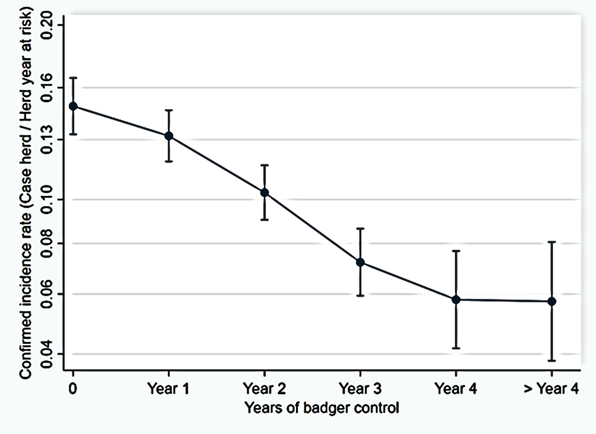
There are two main findings. The first is really good news for farmers, cows and badgers. Data suggests that the cattle-based measures implemented from 2010, and particularly the introduction of the annual tuberculin skin (SICCT) test are responsible for the slowing, levelling peaking and decrease in bovine TB in cattle in the High Risk Area (HRA) of England during the study period, all well before badger culling was rolled out in 2016.
Tuberculin skin tests have decreased bovine TB by around 6% per year in the High Risk Area since 2015, arrows depict start of badger culling
Cattle-based measures also include other controls and measures such as improved hygiene and the use of interferon-gamma testing as a supplement. The downside of the SICCT test however is that it has a relatively low sensitivity; this means it can miss up to 50% of true positive cases. One in seven ‘cleared‘ cattle herds, is not free from bTB, perpetuating the crisis as they are traded and infect new herds. In other words, testing and movement controls need to be further improved to root out the undetected reservoir of disease that remains hidden and undiagnosed in cattle. Cattle measures have brought bTB down by 33% over the last five years and should continue to cause a drop in rates. Declines will slow and stop however as they have in Republic of Ireland without tighter controls and use of new generation testing, as with the ‘Gatcombe’. protocol,
The second finding came from a look at the amount of cattle bTB in areas that had undergone a badger cull and compared it with the amount of disease in areas that had not had culling. This was done over a six year period 2013-2019, so before and after culling was rolled out. Multiple statistical models checked the data on herd breakdowns over time and failed to find any association between badger culling and either the incidence or prevalence of bovine TB in cattle herds. Badger culling efforts appear to be to no effect.
Results showed that that heavily culled counties, culled for longer, had similar disease change patterns to counties culled for just a year or two more recently. Breakdowns peaked on average in 2015, with reductions thereafter. As previously stated, this is well before the badger culls were rolled out in 2016. The analyses do not provide any evidence for the efficacy of badger culling as a bTB control intervention. The results are consistent with predictions by the earlier scientific reference study (RBCT) that badger culling can make no meaningful contribution to the control of bTB in cattle.
Wildlife, farmer money and effort all wasted by the badger culling since 2013
Further, although Defra keep the data based on each badger cull area secret for reasons that are not in the public interest, and in defiance of multiple rulings by the Information Commission, they do claim to have additional data that may be of use in analysis. This may include the number of badgers for which money has been claimed in each cull area.
It is strange that since the legal cases in 2018 when Defra pleaded to the effect that they would ‘adapt (their policy) and learn’, no learning in the form of reporting has been published, which defies legitimate expectations. Is this because their data says badger culling is working? It seems highly unlikely. It seems more likely that it suggests it is not working, which may be why nothing credible has been said about the four years of data since the report on 2013-2017.
Badger Crowd understands that letters will be sent to the government asking them to explain the scientific reasoning behind the decision to phase down Intensive ( 70 %) badger culling in favour of ‘Epi’ (100%) badger culling. Also, asking them to bring the cruel ineffective £100 million badger culls to an immediate and complete end this year as they should have done based on the data and views exchanged with them in March 2021 that were dismissed to allow the killing of an estimated 50,000 badgers last year.
When the March 2020 “Next Steps” Bovine TB policy was released, there was a rumour from inside DEFRA HQ, that its senior officials were secretly in despair. This related to compromises over its content, and the prospects to implement it in the years to come.
The policy was considered by many to be, ‘something for all, but nothing for anybody’. It would require substantial increased public funding to initiate. But it was not, with bTB still spreading, the planned tailing-off of the ruinous public funding poured into this festering agri-crisis over the passing decade.
“Next Steps” formed new mountains to climb, engaging the industry with more regulation: tighter cattle testing and movement controls, and with badger and cattle vaccination. A triple-finance whammy that the 2018 Godfray Review had hinted at. To have legs, it required stakeholder acceptance of just how bad the tuberculin skin (SICCT) test sensitivity really has been, and why ‘TB-Free’ status, after a breakdown is very often untrue, allowing bTB to perpetuate within the High Risk and Edge Areas and to spread further to the east and north via cattle sales. Further, it required their resetting of farmer-psyche to help badgers, the animal they have been told and taught to eradicate, as vermin.
Influence from No.10?
The Prime Ministers interest in Bovine TB, beyond stalling the first Derbyshire cull for a year in 2019, has recently re-emerged. Rather off-message however, regarding the bTB threat in milk to humans, yet perhaps more visibly concerned with the claims of DEFRA, APHA and the Chief Vet’s bungling, in the ‘tough one’ case of Geronimo the alpaca. BTB is going to get fixed, Johnson promises.
Pressure from ‘high up’, had it seemed reawakened the badger and cattle vaccination policy options that rather looked like ‘window dressing’ in early plans back in 2011. Yet officials had just managed to maneuver them in, in 2020, but still to be largely ‘down the line’. To bite financially in a new Parliament. For now, work included a few modestly scaled badger vaccination ‘trials’ and a further look at the doomed immune-based ‘DIVA’ test (See here). Both are the epidemiological equivalents of fiddling while Rome burns. The disease is now so widespread that only mass cattle vaccination can possibly turn the tide.
DEFRA sleight of hand
The main DEFRA challenge in 2020, was how to present a policy moving from ‘proactive’, intensive, mass badger culling, to multiple small-scale farmer-lead ‘reactive-style’ intensive culling, but with minimum outcry. This was somehow miraculously achieved, with a press briefing claiming badger culling was being ‘banned’ or ‘phased out’. This was embraced by those who had not read the small print and who seemed unaware of the ‘epi-culling’ monster described within. Trialled in Cumbria since 2018, the flawed APHA ‘epi-culling’ (see here) approach kills 100% of badgers in a poorly badged ‘Minimum Intervention Area’, and most of them in a surrounding ‘buffer’ area, before trying to vaccinate the survivors left. The Cumbria ‘epi-cull’ has been a total flop, as breakdowns rose again in 2020, sinking the APHA showboat.
Figure 1. All breakdowns in the East Cumbria cull area per 6 month period, showing commencement of enhanced cattle controls and the period with mass badgers culling with a small amount of badger vaccination from 2020.
Derbyshire: a stinging rebuke of APHA ‘Risk Pathways’ approach
As it happens, after 2022, Defra will be running out of large areas of West and Central England to mass-kill badgers. So, it wants to switch to smaller badger killing areas both inside and beyond the High Risk Area, and a future approach that is simpler and cheaper to operate. For this, the Animal and Plant Health Agency (APHA) has been promoting a ‘Risk Pathway’ approach, to try to ascribe badgers as the cause of many or most of the bTB herd breakdowns in, for example Derbyshire. However, the capable Derbyshire conservation folks have veterinary expertise and were onto it with a stinging rebuke of the claim that 77% of bTB in that county is down to badgers (see here).
The original bTB policy promises to undertake badger vaccination, related then to the need to help navigate culling around the national and local Wildlife Trusts, which it did successfully. And what looked like a contrived difficulty in accessing BCG vaccine for badgers in 2015, only lasted a couple of years once, under pressure, Minister George Eustice allowed the switch to a new vaccine brand supplier. Defra had decided that they could not afford to fund badger vaccination or would only fund it on a small scale, with preference for places where badger numbers had been largely culled-out. The cost and feasibility of vaccinating badgers on a large scale was probably never really factored-in at the start, and as the bTB problem has spread, the cost of doing so has escalated.
More badger meddling: a nasty rural conflict with yet more unknowns and complexity
Badger vaccination, like badger culling, holds several important technical uncertainties. The science suggests it reduces the probability of a given badger being infectious. However, as with badger culling, there is no direct evidence that it can help reduce bTB cattle herd breakdowns. The wisdom of doubling the number of uncertain interventions (see here) in tackling bTB in cattle was not lost on Defra. The approach just gives the nasty rural conflict yet more unknowns and complexity. More expense without evidence-base or any credible efficacy monitoring system.
Defra promises to the Bern Convention and a new BTB Partnership
A few weeks ago, government began to reveal what its badger vaccination plans are. Firstly, in a letter to the Bureau of the Bern Convention (see here). While repeating the falsehood of intensive badger culling being phased out, it stated that it would carry out a badger vaccination feasibility trial on ‘unculled’ farmland in a corner (7%) of Sussex, for five years.
A further commitment to train 30 vaccinators (10 a year) from 2022, to cover 2,600 sq km by 2024 was confirmed to the Bern Convention. This is partly it seems, as a replacement for a further five years of ‘supplementary badger culling’ (SBC) for 4-yr culls ending in a few years’ time. SBC is the method fiercely opposed through the High Court in recent years, that the government has pledged to closely report upon, has hidden the results of, and will terminate in January 2026.
In relation to government planning ahead, secrecy appears to surround the new ‘Bovine TB Partnership’ made up largely of farming stakeholders, the voting majority of which clearly want to see badgers culled (see here).
Defra have flagged to the partnership the ‘mountains to climb’ problems (including little money allocated), but they are apparently trying to get the ever-biddable, National Trust to front it. An online Badger Vaccination Conference this summer was shelved and APHA sent away to try do the impossible – find evidence of badger vaccination reducing bTB herd breakdowns.
A bTB ‘cordone sanitaire’ for the Edge Area
DEFRA do still seem to be hanging onto the old ‘cordon sanitaire’ concept for the Edge Area and this may also be a target for the 2,600 sq km capacity by 2024 target. The ‘cordone’ keeps moving back, like an army in retreat, due to infected cattle movements. And it is not much of a ‘cordone’ when unidentified infected cows are being transported by road into and beyond it, with regularity.
APHA has a new mapping procedure that produces their view of where badgers have or have not been infected by cattle. The grey hexagons on their map, they estimate, are bTB free and may be the kind of area for the ‘Sussex’ approach, but what status will they have in five years’ time? In truth, getting vaccination going in the key battleground counties including Cheshire, Derbyshire, Leicestershire, Oxfordshire, Buckinghamshire, Berkshire, and Hampshire would require a ‘cordone army’ of 1000 people and a £12 Million annual budget, just to get off the ground. The cull areas, if not left alone, will need twice or more effort with a bill of £100 Million by 2030. DEFRA’s value for money accounting ‘wonks’ have little hard reference. Like badger culling, there are no measurable benefits to bank. External advice suggest that cattle vaccination will be ruinously expensive too. Which civil servant wants to front these initiatives moving forwards?
The scale of badger vaccination currently described is just a pinprick compared to the military style moblisation of gunmen to shoot badgers since 2013. Further, badger vaccination licence applications are now being discouraged by Natural England in the bTB Low Risk area e.g. in Essex and Herts & Middlesex. This is a significant change to allowing badger vaccination to protect badgers on public and private nature reserves, and other places under threat from diseased cattle in the fields next door.
Defra seems largely to want to vaccinate badgers as a part of a ‘cordone’ and once badgers have been decimated after four years. Not for it to be used proactively to protect badgers which is its only current ethical and scientific application.
Badger vaccination is now being manipulated into being the speculative exit strategy following mass destruction of badger clans. But this year, just a handful of new farms, in a 25 sq km area have been started up, in an area (believed to be in Cheshire) where a new project is pushing the government beliefs. Signing up to badger vaccination is a whole new ball game for those wanting to help badgers. The concern is that in doing so, a system is created where the price of vaccinating badgers is the killing of badgers before-hand or elsewhere, both now and forever, and while the disease in cattle continues.
Vaccination groups and Wildlife Trusts are already speaking out (see here) and seeking much better operational terms that those offered by Natural England, who seem to view the regular shooting of vaccinated badgers as inevitable and acceptable. BBOWT, the Wildlife Trust of Berkshire, Buckinghamshire and Oxfordshire are urging government to develop and deliver a proper badger vaccination strategy, and not secretively and at the current snail pace.
The Geronimo effect
Finally, it is hard not to relate the mishandling of bTB policy in England by DEFRA, over the last decade, including badger culling and vaccination, to the events of recent weeks. The way in which an alpaca breeder Helen MacDonald and her alpaca Geronimo have been dealt with by Defra. The enforced euthanasia and post-mortem of Geronimo, suggesting, in this instance (subject to culturing of tissues) false-positive Enferplex testing, is a very public display of both the inflexibility of government veterinary services and the external pressure of industry bodies, forming and evolving a failing policy.
It is a reminder of why and how on a much greater scale, bovine TB testing and movement control has gone wrong over the last twenty years or more in Britain and Ireland. If Prime Minister Johnson is going to fix the Bovine TB issues in England, then he needs to put a new policy in place with the funding to make it happen. He needs to stop Defra doing ill-advised things that don’t’ work and to kick out those whose actions have made bTB worse in England. Those who have placated commercial interest and allowed vested and biased veterinary inputs to dominate animal welfare and environmental considerations.
Badger vaccination is not a valid exit strategy for badger culling. Badger vaccination should not become a fig-leaf of respectability for a culling policy that just seeks to carry on culling badgers forever.
Vaccinators need to be extremely careful of what they are endorsing or signing up to and how actions in a local area risk complementing and sustaining the routine killing of badgers to 2038 and beyond elsewhere.
Vaccinators should avoid:
Advice that badger vaccination, with epi-culling is a viable way to overcome bovine TB in cattle.
Advice not to support or fund legal action against badger culling in order to qualify for government badger vaccination contracts.
Offers of funding and staff posts for ‘buying in’ to the government’s ‘epi- culling’/vaccination plans.
Vaccination contracts with non-disclosure clauses, requiring vaccinators to;
Be silent on cruelty and opposition to badger culling.
Share sett data with cull companies.
Accept that vaccinated badgers may be shot occasionally or even routinely.
Suggest or imply to farmers that badger vaccination may help reduce bTB in cows when this is not known.
Last Thursday 23rd September, Hertfordshire and Middlesex Badger Group hosted a webinar to look closely at the governments “Next Steps” strategy for achieving bovine tuberculosis free status for England.
Ecologist Tom Langton kicked off the event with a presentation on the policy as it relates to badger vaccination. It was very sobering. In contrast to the headlines that accompanied the announcement of the policy (‘Badger Culling to be Banned’ was what much of the mainstream media ran), badger culling looks set to continue, although in a different guise.
Large scale culling (of 70-90%) of badgers is to be replaced with localised 100% culls, with the example of the Cumbria 100% cull as the policy model. Cattle herds in Cumbria (Area 32/hotspot 21) are still experiencing high numbers of bTB breakdowns despite three years of culling & now farms have many ‘dead’ setts. One badger has been vaccinated for every ten shot, and some vaccinated badgers may already have been shot.
The chief vet will be able to authorise localised culling based on the new ‘epi-pathway’ approach. Basically, this means that if local vets cite badgers as a likely source of infection, such as infection found in just a few badgers, culling can be licensed.
APHA ‘risk pathways’ approaches do not factor in the low sensitivity of some of the bTB herd testing being used, leaving up to 50% of infection undiagnosed in the herd. Cattle are still the biggest, if not only source of bTB infection, but APHA just refuse to take full ownership of the problem.
So how is Defra going to sell this shocking new ‘cull and vaccinate’ policy to the public, those of us who passionately love our wildlife? It looks as if they are trying to ‘normalise’ culling by engaging voluntary groups to get involved in vaccinating a proportion of badgers. The problem with this approach is that participants will have to comply with government by stopping opposition to culling, by handing over sett data, and by telling farmers that badger vaccination will reduce bTB in cattle. None of these things are acceptable.
Born Free veterinarian Mark Jones made his position clear: we “…need to avoid getting drawn into a situation where there is tacit acceptance of a system that seeks to secure de facto support for culling, with vaccination used as an exit strategy from it”.
To find out more about what the government has planned for our badgers to 2038 and beyond, watch the webinar recording here.
Permission granted for Judicial Review of aspects of the 2020 “Next Steps” bTB eradication policy
On 9th May, the Court of Appeal granted permission for a Judicial Review, with a ruling by Rt. Hon. Lord Justice Bean. The Ground of challenge approved for scrutiny concerns a decision made by the Secretary of State George Eustice in February 2020, just after he took over from Theresa Villiers. In March of that year he signed off a “Next Steps” policy to continue culling badgers.
The legal challenge maintains that the new policy was formed without adequate regard to conserving biodiversity, as is required by duties under section 40(1) of the Natural Environment and Rural Communities (NERC) Act 2006. These duties are far ranging and relate to protection and recovery of biodiversity in England. Not just specific duties to internationally protected species and sites. The case has been brought to the courts by ecologist Tom Langton, following a grant last year from the Badger Trust to help instigate challenges against the new policy.
Very many people have been concerned about how removing badgers from county wildlife sites and fields, woodlands and quiet corners in the landscape influences nature on a local level, especially as the policy has moved towards 100% eradication of badgers locally. The new proposals promote the further phasing in of ‘reactive-style’ culling as a full replacement towards the end of the decade to the current intensive and supplementary culling approach.
A legal letter sent to Natural England (NE) has made it clear that they should not issue any badger culling licences this year as a result of this ongoing oversight. It is an omission that has been persistent since 2013 and it is now part of a complaint accepted at the Council of Europe’s Bern Convention. An urgent Court hearing is being sought for this June.
Legal wheels turning again with new pre-action letter
The second matter relates to a previous Badger Crowd blog introducing analysis of official data from 2010 to 2020. Figures released on 10th March of this year complete the data for four full years of culling over six areas. The data shows no significant difference in bTB levels between areas culled and those unculled since culling began. Further data from each of the main High Risk Area counties is consistent with cattle measures gradually becoming effective before badger culling started.
Bovine TB breakdowns (herds bTB Free status withdrawn) peaked and was in decline before badger culling became widespread. A detailed report on this data has been sent to Defra and NE as new findings. What more evidence could NE want that badger culling is unsafe under Section 10 of the Badgers Act 1992?
NE have released, under Freedom of Information request, documents showing how far badger culling has drifted from policy science (The Randomised Badger Culling Trials: RBCT). Culling rules now move closer to a free-for-all, with culling over wider areas for longer and with new speculative methods. Immediate concern relates to ten potential badger cull areas that could be licensed for intensive culling for four year culls, starting this September, with a further ten next year.
All of this legal work will require funding to pursue and coffers are nearly empty. There is need to gear up for some emergency fundraising over the next few weeks and reach out widely to gain support. Please look out for a crowd funding link and for information on where donations can be sent. It is hoped that supporters can once again rise to the challenge and give badgers a chance to roam undisturbed across the fields and woods of England. We will continue to seek justice in the best interests of badgers, wildlife, farming and the public. The bovine TB crisis must focus on the cause of the problem; the spread of disease amongst cattle.