
Welsh Government’s new plans to kill largely healthy badgers, using discredited scientific arguments sourced from England

With a newly elected Plaid Cymru-led government, badger culling is back on the agenda. And behind the scenes, plotting has been uncovered. Disturbingly, this is under Labour’s watch – what were they thinking? So what is the history of badger culling in Wales, whose TB control in cattle has matched that in England, without harming badgers at all?
Historically
Between 2017-2023, the Welsh Government (WG) ran an experimental Test Vaccinate Remove (TVR) project. This ran into huge problems due to a conflict between the ‘Sophia’ vaccine and the DPP test (to test cage-trapped badgers for bTB). The result was the inadvertent (or otherwise) killing of mostly vaccinated badgers. The total cost of the abandoned project was an eye watering £1,695,465. A total of 99 badgers were euthanised leaving the taxpayer to pick up the bill of £17,125 per badger. It was an expensive fiasco resting on poor advice and technology.
Who’s in charge now?
The Welsh Government Bovine TB Eradication Programme Board (TBEPB), dominated by industry interest, had its inaugural meeting in December 2024. As in England (the equivalent and notoriously bad BTB Partnership), this board is drawn heavily from the farming and veterinary industry. As of March 2026, it comprised:
- A representative of the Technical Advisory Group (TAG, an independent expert panel that provides scientific and practical advice to the Welsh Government on its bovine Tuberculosis (TB) eradication programme)
- 4 farmers, one of whom is Chair of NFU Cymru bTB focus group
- 3 vets
- 1 NFU representative
- 2 anonymous APHA attendees (Defra are trying to influence Wales policy)
- 2 anonymous Welsh Government officials and CVO (Richard Irvine, formerly deputy CVO Defra)
- A former Rural Affairs Minister with previous experience of overseeing a proposed cull in the IAA that was prevented by a High Court Judicial Review.
There is currently no representative from any wildlife or scientific organisations. (See here)
What did the board say at their latest meeting?
The board has engaged in a detailed discussion about its guidance on wildlife, covering the following points:
- A comprehensive cost-benefit analysis should be conducted, with particular attention given to budgetary considerations
- Decisions should wait for data to ensure any intervention is evidence-based
- A wildlife representation should be included on the board
- There was a necessity to identify pilot areas for intervention as soon as possible in order to initiate project activities
- The board reviewed area-specific intervention strategies, including the use of England’s cluster template and potential mapping of clusters using epidemiological and local knowledge
- Support was expressed for increased cattle testing in hotspot regions and for differentiating between minor and serious infections
- Methods for tracking epidemiological changes were considered, with an emphasis on robust data and evidence-based recommendations
- APHA was requested to begin mapping interventions implemented in England for possible adaptation in Wales, covering both wildlife and cattle concerns
- Discussions included cross-border data sharing, improved communication among vets, delivery partners, and farmers, and the proposal of appointing a “TB Tsar”
- The board debated pursuing either a single holistic policy or multiple updates throughout the year
- The Chair was to share the previous RAG spreadsheet outlining initial priorities
This meeting of the TBEPB on March 11th, shows chillingly how almost nothing has been learnt from the past. Defra’s ‘carry on regardless’ attitude is being foisted onto Wales. It is founded in scientific denial, utilizing the failed badger interventions from England, and is also being promoted by Defra in Northern Ireland. The Government consultation on the Godfray review update (2025) with a refreshed bTB strategy is being awaited. As yet, the nature of the interventions being considered is unclear: badger culling, vaccination or a fruitless combination of both, as greenlighted by the Godfray panel?
Targeted culling is back on the agenda
The reference of the board to bovine TB “clusters” could indicate that targeted culling is their preference whether or not it is dressed up in a new name. This was the subject of Defra’s March 2024 consultation, issued under the previous English Tory government. Neither the outgoing Tory, nor incoming Labour Government reported on its results (see link).
This 2024 consultation set out proposals for badger interventions in England. The focus was to be badger culling and vaccination in the targeted areas. These areas would be known as clusters, but would effectively be large cull areas, as before. The stated objective, based upon now obsolete science, was to reduce infection of cattle from badgers by killing most of the badgers in a given area. Culling was to continue until the cattle breakdowns inside the cluster had reduced to a level where it was no longer deemed to be a cluster. Badger vaccination was then to take place as an exit strategy. The problem with this approach is that the risk of infection from badgers has yet to be evidenced, as has the efficacy of killing badgers to reduce bTB in cattle in the Low RIsk Area, as elsewhere.
In the Low Risk Area, government now say that they don’t need to see benefits from badger culling. BTB incidents will decline due to cattle measures, but they now say they do not need to ascribe any proportion of this decline to badger culling. They claim nevertheless, that badgers need to be culled because of the “perception” of risk. A complete fantasy veterinarian muddle. No need to see if it works – no certainty – just carry on regardless.
Targeted culling follows same methods as failed English LRA culls?
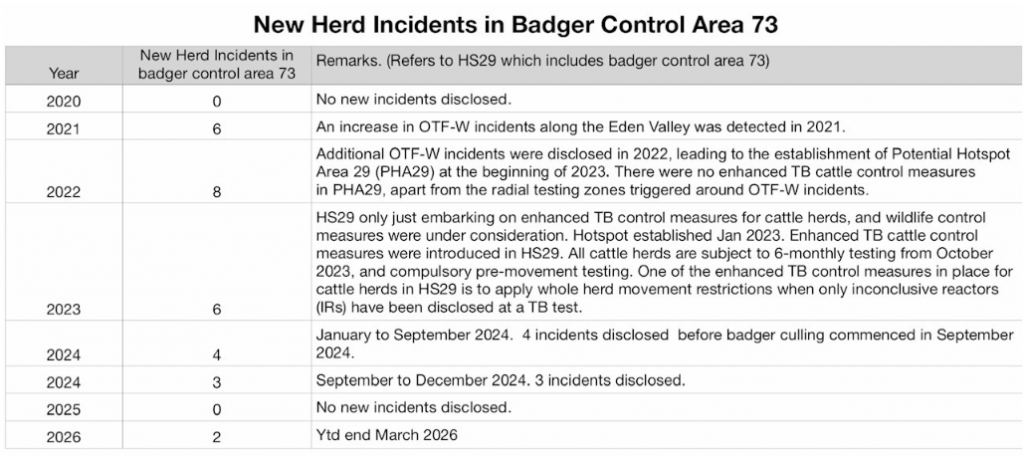
As indicated above, targeted badger intervention (or epi-culling) broadly follows the Low Risk Area culling policy in England. But analysis of the data from the LRA cull areas in Cumbria and Lincolnshire gives no indication that any of the three areas, Lincolnshire 54, Cumbria 32 and Cumbria 73, have benefitted at all from culling.
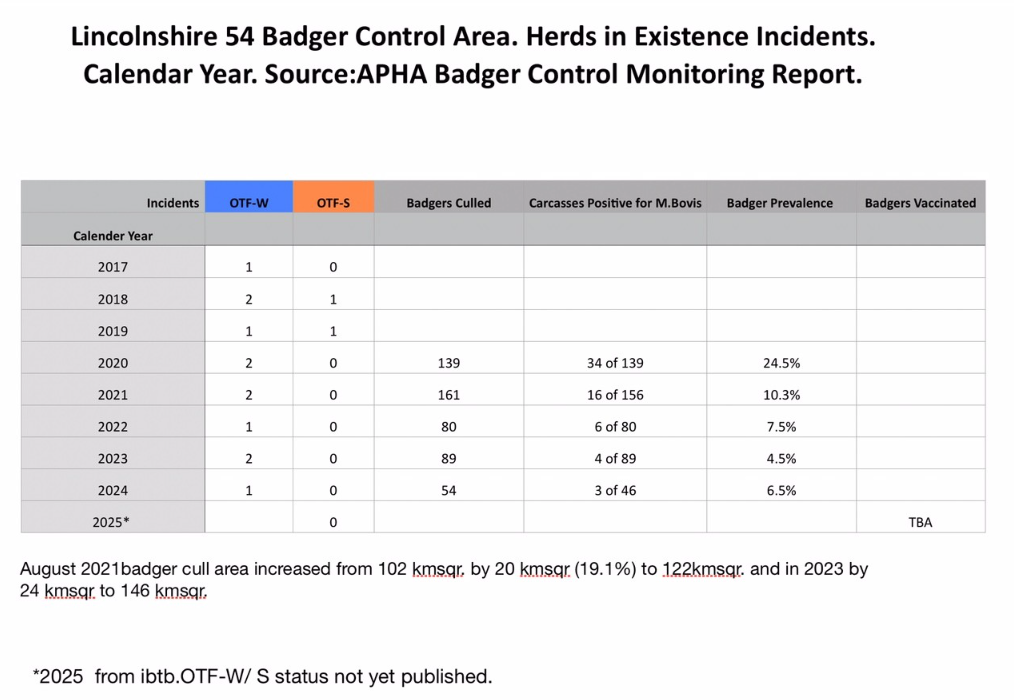
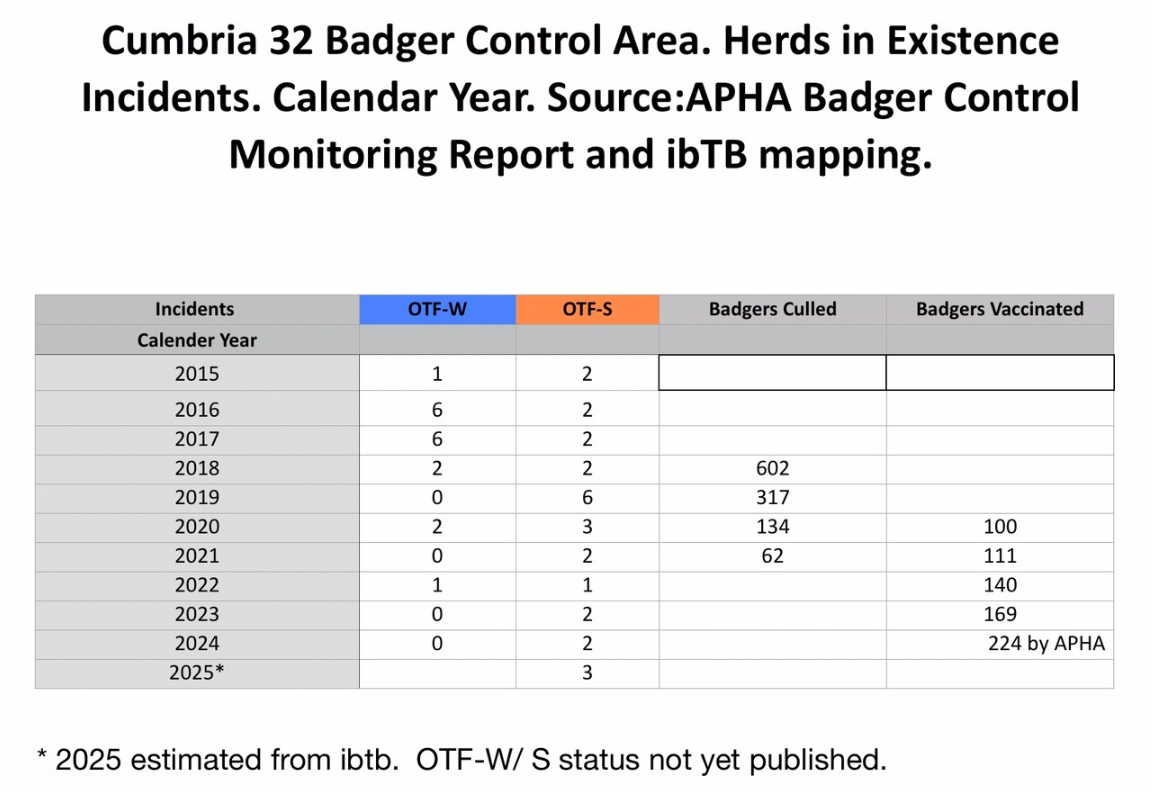
Data from Badger control area 73 shows how it is the enhanced cattle measures and increased sensitivity of testing that have reduced bTB, before culling was implemented.
The December meeting of The TB Eradication Programme Board
At the December meeting of the board (link here), Professor Glyn Hewinson, TB Advisory Group (TAG) Chair, gave a comprehensive presentation on his opinions about wildlife and bovine TB transmission, claiming the need for a national policy to prevent transmission from wildlife to cattle, and emphasising ‘evidence gaps’ in Wales. The board discussed the importance of an ‘evidence-based’, holistic approach, the necessity of further data, modelling, and stakeholder engagement. This is terminology that the failed Defra ‘songbook’ has used for 13 years or more – it’s now being imposed on Wales.
But Defra is still resisting and apparently in denial about published science that shows that badger culling efficacy to date has been based on estimated benefits from flawed statistics (Torgerson et al 2024, Torgerson et al 2025, and Torgerson 2025). Evidence for a disease benefit from badger culling is equivocal at best. At worst it is held in place by conspiracy. Defra continues to ‘posit’ that industry led culling has resulted in a disease benefit to cattle, but is unable to produce evidence of this. And again resists published science that evidences a lack of benefit from industry led badger culling since 2013 (Langton et al). Defra has recently issued an apology for attacking the authors of this peer-reviewed paper in a manner that breached government standards. This is Defra’s second apology for getting it wrong.
Ominously, TBEPB vet & farming industry members reached agreement on both the wording and the overall strategic direction.
Even more ominously, the Chair noted that publication and subsequent engagement will require careful political handling, given the sensitivities surrounding the programme and its stakeholders.
Bad advice is ready to cripple BTB control in Wales for a generation by not heeding Defra’s English bTB failings. It began with the ashes of MAFF and has continued in the same scientifically flawed manner.
They can learn by listening, engaging with independent scientists. They must avoid advice from those who want to impose their long held mistakes and misunderstandings rather than admit error. It can be done now, or in court and the court of public opinion. It’s their choice.